Showing posts with label Vietnam. Show all posts

Monday, January 30, 2023

Playing the Nam: comparative review of Vietnam Wargaming rules

When I started to collect and paint 28mm Vietnam figures and models, little could I suspect how much there is to learn about that period. One area in which the versatility of the period manifests itself is the number of rulesets you can use to wargame it. We are spoiled for choice.....

Below are a number of sets I tried or will try with their relative merits and weaknesses (as perceived by me). Wherever a review of the entire set is availabe I will link to it. 

NB: I limit myself to reviewing platoon level sets, for the simple reason that I will only review rulesets I have played or will soon play. Lacking a company-level miniatures collection, company-sized rulesets are not in scope for this blog. 


Regular readers of this blog will know I am a sucker for any wargame that drags the Cthulhu Mythos into its rules in any decent way. So when Crucible Crush and Bob Murch of Pulp Figures' fame announced a "Weird War Vietnam" ruleset I was immediately interested. Frankly, this announcement was what got me into collecting Vietnam figures in the first place. Leaving aside the Cthulhu Mythos monsters BS turned out to be a rather enjoyable game to play Vietnam. 

Black Sun is specifically written for the Vietnam conflict and is for the most part a tried-and-tested IGO-UGO rules mechanism with a few interesting innovations. 

You build your force by choosing a Force Card containing a leader (Boss) and using his point pool to buy more force cards from the same faction. The force cards are the building blocks for any force and are included in the rulebook to be scanned and printed.

Keeping in mind that the tables you need to determine things like Wound- and Activation results will eventually settle in your memory the game plays pretty smoothly. Activating, moving, spotting and shooting work fine. Gunfire is bloody, so sneaking and using cover really are important, as it was in reality.

The Spotting rules really enhance the feeling you are sneaking through a jungle, know that the enemy is somewhere but cannot always see him.

The game played smoothly, giving a good impression of small unit jungle warfare in the 60ies. The impact of morale and suppression is quite limited, which I missed to be honest, but in the end this is a rule-mechanical choice based on taste since such things will slow down the game. I know for a fact that not all wargamers appreciate their little metal men to cower or run because of a bad Morale roll....

Caveat
The rulebook, it must be said, contains some choices I do not understand and a number of mistakes in rule- and example texts.

Of the latter, the most disturbing ones are dealt with in the Errata list provided on the website by Crucible Crush, together with a new QRS that corrects a few typos in the Weapon list. Mistakes will occur in any book, but I feel this one could have benefited from better and more thorough editing. Nevertheless, this can be solved by using the Errata.

The rulebook also includes stats for some weapons, like mortars, but no Force Card for such units to include them in your force. Since Force Cards are the only way to include them and no points cost are provided, you cannot play those units despite the fact that they are mentioned and detailed in the book.

I understand a number of these things will feature in future supplements.

Conclusion
For a Weird Nam Game, there is plenty of good Nam gaming going around, but not nearly enough Weird. For a modern skirmish game the effects of gunfire on group morale and movement are very limited. I personally think these effects should be more severe as that would be better suited to the period, but I understand the choice for less impact from shooting and casualties came from playtesting.

There definitely is an enjoyable game here, but it takes some work to get your hands on it.

BOHICA/Danger Close

DC is a (kind of) alternate turn skirmish system meant for modern wargames with a few dozen figures and some vehicles. The set is stunningly compact: only 2 pages plus another 2 pages fr vehicles. That's all. 

Turn sequence is determined by troop quality, the best activating first. 

Troop quality also determines how many figures you may Activate in your turn as well as maximizes the number of actions a figure has per activation, the best having more actions. So a figure might perform 2 to 5 actions per activation and can be activated once per turn. Finally, troop quality gives modifiers based on the difference in quality between opponents in spotting your opponents, shooting in a firefight or combat. So better troops move sooner, can do more and are more effective in combat and firefights.  All based on one stat. Very elegant. 

For compactness and price this game wins everything hands down. The ruleset is clear and brief and logically structured. Being essentially only 2 pages long, it does not need an index. Just turn the page. 

Activation and Morale are quick and easy and the quality difference between troops is done very elegantly. There is hardly any bookkeeping needed besides Stress, injuries and Overwatch.
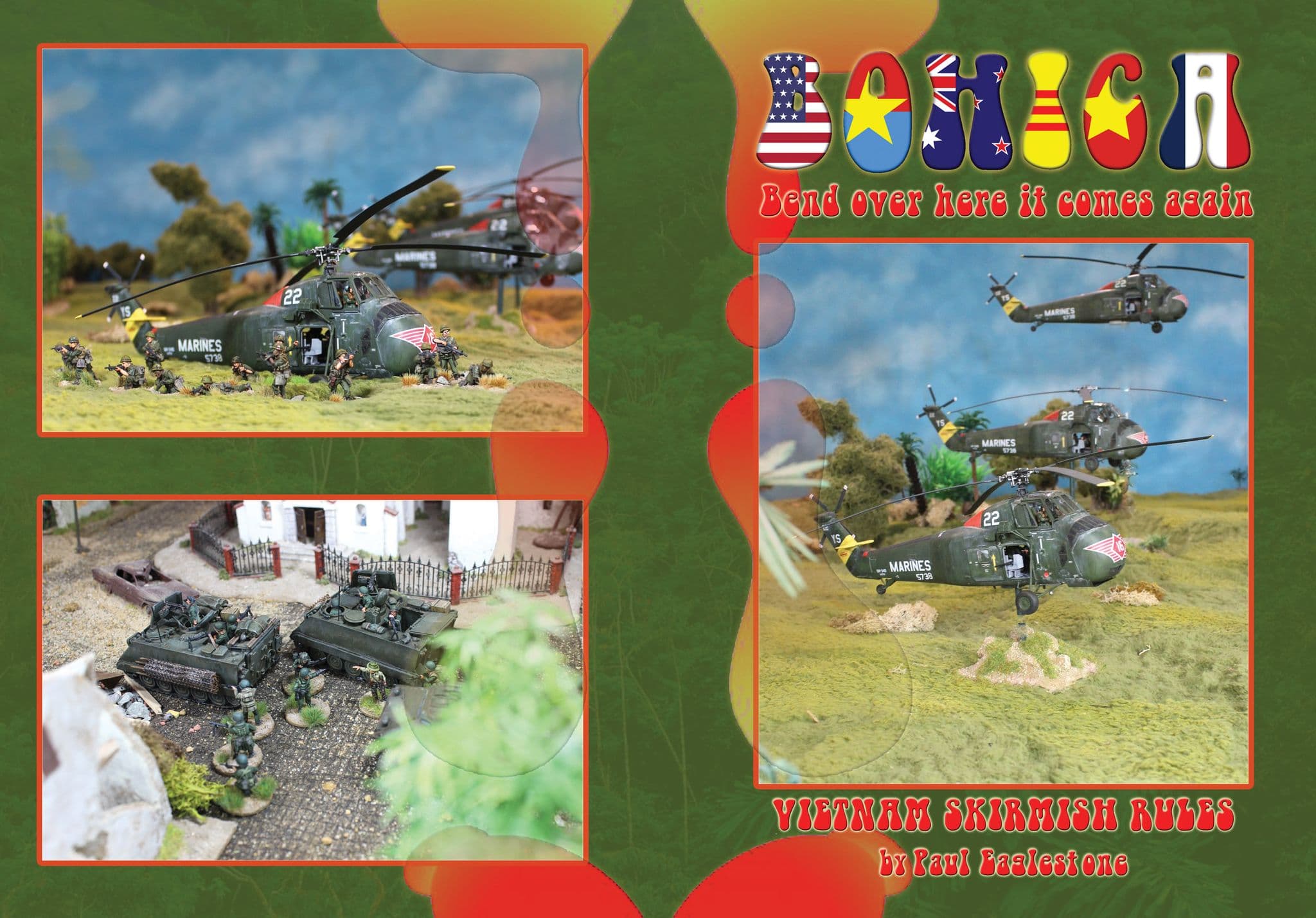


BOHICA is DC's much bigger offspring: a fully fleshed-out ruleset based on the same mechanics but much more elaborate. Here are pictures, explanations, diagrams, scenarios and ways to set up your table, unexpected events et cetera. Where DC is a set for the experienced wargamer who doesn't need much in the way of explanations, BOHICA can be picked up by any aspiring wargamer as a starting set. The rules are explained very well and even include practice scenarios to learn specific parts of the rules. 

BOHICA is written specifically for the Vietnam period and benefits from this. There are rules for things like helicopters, napalm and other iconic aspects of the Vietnam war. 

FNG Tour of Duty

Two Hour Wargames' take on the Vietnam war. They use their tried and proven game engine we know from (amongst other games) All Things Zombie. 

FNG comes the closest to a RPG system in some respects. Players (or player, since his game enables solo play) step into the shoes of a infantryman in Vietnam during the 60ies. 

Troops are divided into Stars, Grunts and Non-Playing Characters and can be part of any side in the Vietnam conflict. Stars can get all kinds of traits and quirks to individualize them, something that really shines in the Saturday in Saigon games (see below). 

The system has a very elegant mechanic based on only one stat (Rep). The game is geared to the infantry, so there is a lot about infantry ground combat, boobytraps, grenades and choppers, but no tanks, vehicles, planes and stuff like that (or it would be an anonymous bombardment from above).

The game is quite versatile and offers three gaming scales/variants: 

  • Tabletop style: a normal tabletop wargame on a 3x3' table using up to 40 or so miniatures per side
  • Battleboard Style: a more abstract game using a map and moving from map section to map section. The game provides counters to use a a substitute for figures. This kind of looks like a boardgame/wargame crossover, although it can be played on a tabletop too. 
  • A Saturday in Saigon: a wargame/RPG-like crossover version where a handful of miniatures on the board interacts with Non-Playing Characters. This reminded me the most of the ATZ games I used to play. 
The game also facilitates solo play as wel as a campaign, in which al these variants can be used. Honesty compels me to admit I have not tested these rules yet, but my experience with the ATZ rules that are quite similar to the Tabletop/Saigon game styles makes me suspect this ruleset can produce quite an enjoyable game. 

Unfortunately I have not yet found a comprehensive review of FNG. There are a few Youtube vids and some blogs about the Battleboard variant, but nothing attempting to address the entire ruleset.  

Force on Force/The Next War

TNW is a Modern-to-near-future-to-hard-SciFi ruleset and is based on the Ambush Alley reaction system, just like Force on Force. There is actually no turn order. Every turn players dice for the "active" player who is the first to do something. As soon as he activates one of his units, the other "inactive" player can respond. Because the inactive player is actually not inactive at all! 

Players test against each other (highest roll wins) whether the action or reaction takes place first. Is the active player completely at the mercy of the inactive player? No, because he can prepare for reactions by putting units in Overwatch at the beginning of his turn. They can try to interrupt or prevent a reaction. 

As a result, a simple movement of figures can have dynamic consequences. They can be shot at by units of the inactive player before or while they are moving. If they win their test, they can shoot back. The inactive shooting units, in turn, can also be shot at by active player units in Overwatch before they can perform their action. The reaction can also be used for other actions such as ducking into coverage and other things. If the active player has activated all the units he wants (maybe he keeps a few to respond to the inactive player) it's the inactive player's turn and the same interaction is repeated.

This cycle of action and reaction is finite. Troops cannot respond to return fire and Overwatch, may not shoot more than once per turn at the same enemy unit, and figures that have already been activated may not be activated again. 

But just as well, a single movement can provoke quite a firefight and delivers an interesting game.

TNW uses almost no dice modifiers. Instead, it uses dice with 6, 8, 10 and 12 sides. The better the quality of the troops or the cover, the "higher" the dice. In principle, a 4+ is a success. Most of the rolls are "opposed", made against each other. This means that a result of 4+ is usually a hit unless there is a Defense throw of at least 4+. 

The rules are clear, uncluttered and displayed in a logical order in a pleasantly readable font and each paragraph contains a clear summary in an easy-to-find text block. 

The rules start with a table of contents that is so detailed that it can actually double as an index. There are scenarios, ready-made units and vehicles and the so-called Fog-of-War cards, which are intended to make scenarios a bit more unpredictable.

There are different classes of troops, from angry civilians to elite commandos and all kinds of specific traits for troops, some of those specific to SciFi games. 


Being a generic modern ruleset, tailoring it to Vietnam is quite easy. An additional advantage is that the rules are retro-compatible with all scenario books that AA has ever released. Arguably the best in the entire hobby and including a Vietnam book: Ambush Valley. This book, still available in PDF format, will provide you with all the details to play the Vietnam period. 

NB: TNW in this stage is a PDF document in development and therefore a bit Spartan in layout. No pics and no diagrams, so for the experienced player. Buying it gives you access to all subsequent editions to be published in the future, including, I understand, the final and complete PDF book. 

Spectre Operations

SO is written for 28mm Modern Warfare. This is a wider scope than one might suspect, since the ruleset essentially covers all forms of skirmish combat using modern weapons. And by modern weapons I mean everything from the bolt-action rifle and Maxim gun onwards. It can be used for everything starting around 1900 and I played 21st century conflicts with it as well asWW1 with equal ease and success. 

The secret of this lies in the set's flexibility regarding tactics and weapons. Regarding tactics things like formations and movement are quite free-flowing, and and are basically only important when orders need to be passed on. Very green troops, like militia, benefit from close formations where morale is concerned but all other troops can adopt tight or loose formations as desired for practical purposes. 

Weapons are dealt with in categories, for example the Assault rifle. This line gives stats for all assault rifles, be it M16s, FALs or AK47s. The game assumes that difference in details between weapons within a category is way less important than the level of training of the troops.  

Being a Modern ruleset weapon categories cover everything from bows to laser guided bombs and drones. Vietnam era weapons translate flawlessly into the SO weapon categories. 

Giving importance to troop training levels, the set is eminently suitable to assymetrical play which is so defining for a large part of the Vietnam conflict. Assessing troop levels is also a tool that can be used relatively to balance the scenario. So Special Forces Recon may always be Professionals but may also be Elite, Professional or Trained depending against who they are pitted. Between troop levels Civilan, Militia, Trained, Professional and Elite you will find a place for everyting. 

Although not meant for lage numbers of vehicles, the game handles them quite well. These too are put into categories. While it might not be to everyone's taste to assess both a Patton and a T54 as "Cold War Era Tank" it works quite well game wise.  

There is no exhaustive list of Vietnam era vehicles compared to SO vehicle categories, so some creativity and period knowledge is needed to differentiate between a T54 and a PT76. But there is a category for everything. 

NB: Spectre Miniatures has announced it wil cease supporting Spectre Operations as a ruleset, since it was licensed from its author and that license will expire soon. The author has made it known he is working on a successor ruleset under the working title of Assymmetric Warfare. I refer to the Facebook group for news.  

Bello Ludi Vietnam

To be commented on in this spot in the near future.

 NB: Charlie don't surf

I am of course quite aware of the existence of the excellent ruleset Charlie don't Surf by Too Fat Lardies. However, since my focus for gaming Vietnam is 28mm Skirmish (be it small or large) and CDS is aimed at 15mm Company level wargaming, I have omitted the ruleset from this review. 

Hopefully I will get to play it one day, but lacking a 10 or 15mm Vietnam collection, including terrain, this might be a while.....

Conclusion

It would be a bit premature to choose a "best" set before I have played them all and I am loathe to do that anyway since so many of the aspects of the best set for me are ultimately a matter of taste. 

However, when asked to voice a "preferred" ruleset I would opt for Spectre Operations for being immensely flexible, quick-playing, relatively uncomplicated as a ruleset and still providing interesting choices during the game while maintaining a recognizable feel for modern combat as far as I can be the judge of that.  


Sunday, January 23, 2022

The final figures for the Vietnam project.....for now.

 For now the final ones. All that remains now is some more terrain: rice paddies and colonial buildings. And then the wait is for new releases. 

DCC 1/43 diecast Jeep plus Empress 28mm crew


Empress USMC mortar and crew


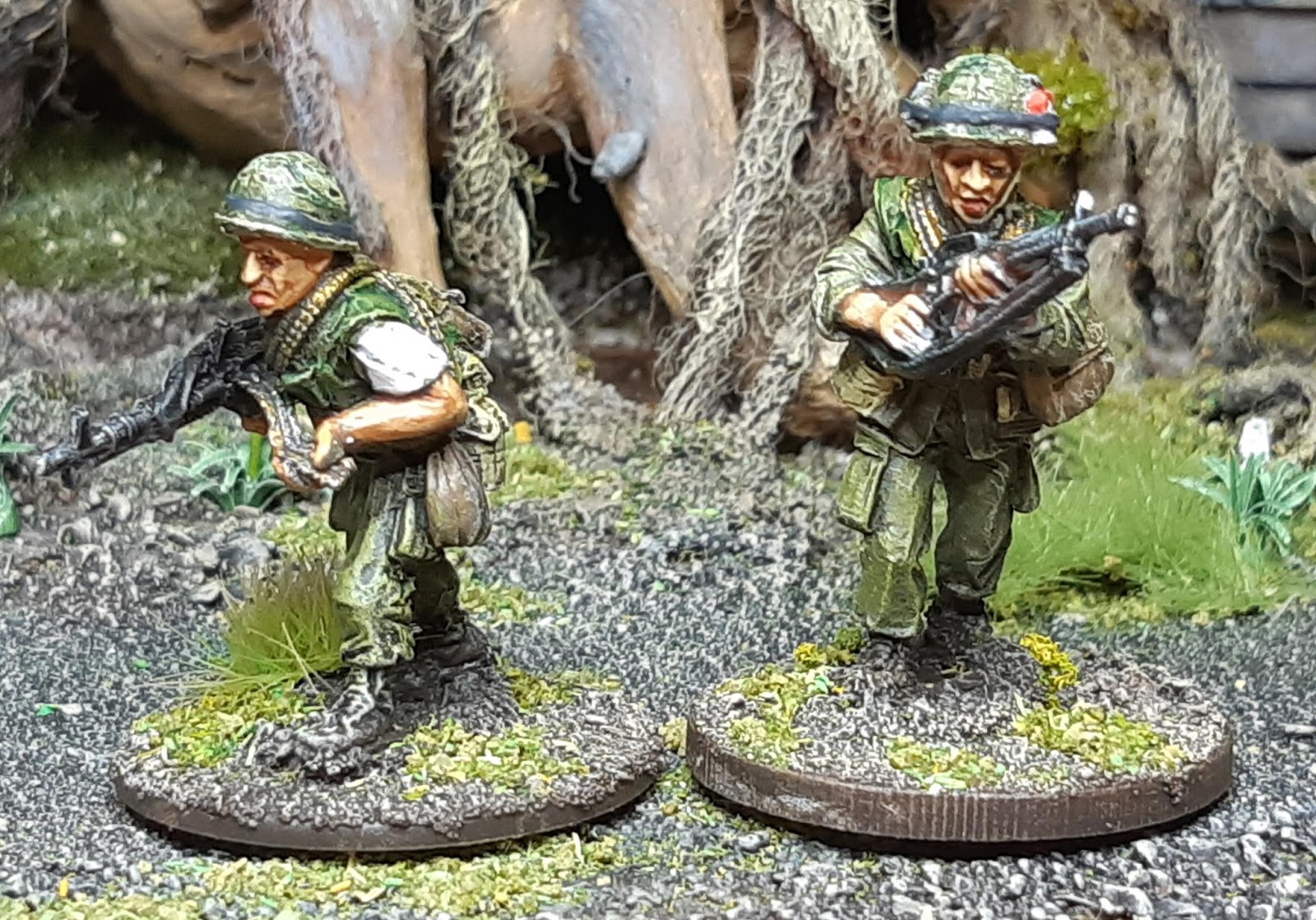
USMC with .50cal and M16 with night scope

USMC medics

Gn Sgt Hartmann & Pvt Pyle

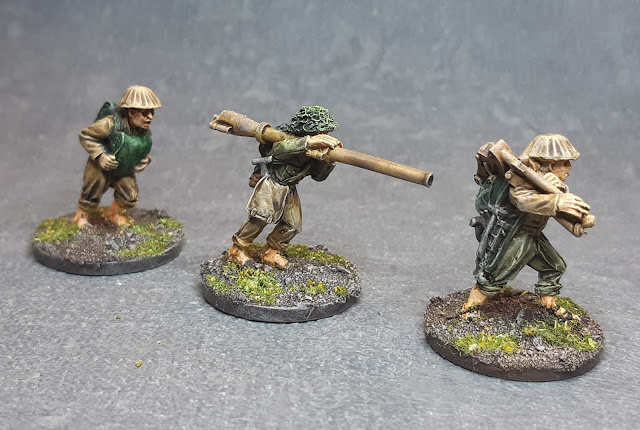
Type 54 recoilless rifle on the move

Type 54 recoilless rifle at the ready

Vietnamese mortar with crew

An M40 recoilless rifle for the Marines and a commander for my Ontos


Sunday, January 9, 2022

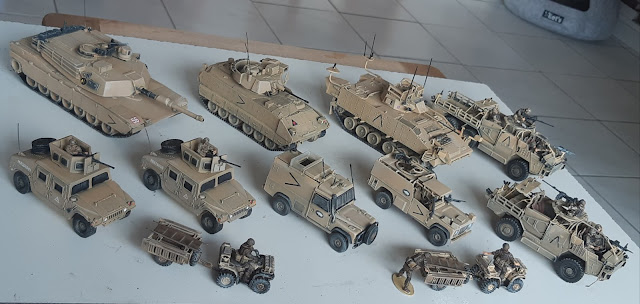
The vehicle park for Vietnam and Modern so far

My 28mm vehicle park so far. I might have overshot my mark here...

US vehicles by Empress, UK vehicles by Airfix
 

Trucks by Rubicon, the rest by Empress

PIBR by Empress. The choppers are various kits


Sunday, May 9, 2021

Expect the worst. A Vietnam wargame scenario


 "What's gonna happen in the village, Sarge?"

"Expect the worst, kid."

"What's the worst, Sarge?"

"Whatever you don't expect, kid"


The downside of most wargame scenarios is that both sides usually have a pretty clear idea what to expect. This scenario idea tries to remedy that. It is written with 28mm figures and the Spectre Operations rules in mind, but should be adaptable to other rules and scales. 


It starts....

From the USMC point of view, this scenario starts with a patrol marching up to a Vietnamese village in the Highlands, sometime in the late 1960ies. The patrol may be any size, from a squad up to a full platoon. Just find a way to scale up the opposition in such a way that the scenario remains a challenge and will not become either a walkover or a certain defeat. 

The table.

In all cases the table is the same. A marching route leading from the US side of the table along its length to a Vietnamese village situated roughly in the middle of the table. The road up to the village starts in woods, then the terrain opens up to run through into some rice paddies, dotted here and there with a copse of trees or palms, to arrive in the village. The rice paddies are bordered by more woods towards the edge of the table. On the far side of the village the terrain is about the same: rice paddies, a road and woods. One long side of the table might be a river. This might enable marine assets for both parties, but might also limit ambush opportunities. 


The Mission

The US patrol is tasked with inspecting the village on a routine patrol. The village has been visited before. There is no intel indicating any specific danger, but then this is Nam and what was safe yesterday might not be so safe today.....

The patrol has been ordered to engage enemy forces at their discretion, possibly eliminating Vietcong cells and gathering intel on more interesting discoveries. They will retreat in the face of superior hostile forces. The LZ for extraction is off table on their table edge of entry. They have the opportunity to call for artillery support or even air assets which might or might not be immediately available. 

The scenarios

While the US player always starts with the same resources and the same jump-off point, the Vietnamese player must not. He has the choice out of several scenarios which each offer him different resources and objectives and may choose one, unknown to the US player. 

The start of each scenario should be indistinguishable from the start of the others. 

US resources: 

  • Artillery: the US player may radio in Artillery as long as he has a working radio. He may call in an artillery strike on any table location. The strike arrives if, where and when in accordance with the chosen rule set. 
  • Air support: the US player may radio in Air support as long as he has a working radio. He may call in an air strike on any table location. The strike arrives if, where and when in accordance with the chosen rule set. 
  • Medevac: the US player may evacuate wounded in two ways: carry them off table via the US table edge or picking them up by helicopter from the table.  

Scenario 1: Ambush

The village has been thoroughly infiltrated by the VC. Nearly every villager is a dedicated cell member and armed. Weapons are well hidden on their person or in the vicinity  and a number of VC is hiding below ground, waiting to spring the trap at the right moment. 

Special rules

  • The VC have approximately the same strength as the US patrol. 
  • They may place at least two hidden bunkers and six hidden tunnel exits on the map. 
  • They may then allocate any number of troops to each and any of these locations. 
  • On top of that, any number of the visible Vietnamese peasants may also be VC. These have to be indicated in writing beforehand so as to prove the locations and peasant figures are indeed VC. 
  • VC may also be hidden in houses or numbered locations on the table.  
  • The VC player does not get any reinforcements in this scenario. 
  • Possible locations for bunkers, tunnel exits and places where VC might hide may be Spotted by the US player. 
  • Peasants may be Spotted (as VC if they are) within 2 inches.  
  • The VC has orders to inflict as much damage as possible on the US patrol, take prisoners if possible and retreat in the face of superior hostile fire power.

Victory conditions

US Patrol: 1 point for each wounded US trooper evacuated alive. 1 point for each VC trooper killed or captured. -1 point for each Vietnamese civilian killed by US. 
VC: 1 point for each US trooper killed. 2 points for each US trooper captured alive

Test game: to be reported.

Scenario 2: Patrols meet

The patrol encounters enemy resistance in the form of VC and/or NVA occupying some hidden positions at the Vietnamese side of the table  and gradually filtering onto the table from the Vietnamese table edges. This is a Vietnamese patrol of about equal strength as the US. They lack real artillery support but have the benefit of occupying a number of hidden positions on the table at the start of the game. They might have a mortar or two off-table at their disposal. 

The Vietnamese player has orders to engage enemy forces at their discretion, possibly eliminating US patrols and gathering intel on more interesting discoveries. They will retreat in the face of superior hostile forces. 

Special Rules

  • The VC player has the same amount of troops as the US player. He may deploy from any or all of the Vietnamese table edges. 
  • The VC player may place at least two hidden bunkers on the map from his short table edge onwards up to the US edge of the village and six hidden tunnel exits anywhere on the map. 
  • The VC player may allocate troops to these locations at the start of the game, as long as they are o the Vietnamese side of the village.    
  • The VC player does not get any reinforcements in this scenario. 
  • The VC player may attempt to call in mortar strikes once per turn as long as he has a working radio. This will succeed on a roll of 4+ on a D6. 
Victory conditions

US Patrol: 1 point for each wounded US trooper evacuated alive. 1 point for each VC trooper killed or captured. -1 point for each Vietnamese civilian killed by US.
VC: 1 point for each US trooper killed. 2 points for each US trooper captured alive

Test game: to be reported.

Scenario 3: Weapon stash

The village includes a large VC weapon stash and is actually an important logistical hub in the Ho Chi Minh Trail. The stashes will be easily found once the US enters the village and starts searching houses. The VC has been alerted to the US patrol rather belatedly and has just had the time to post some ambush VC troopers amongst the villagers at work in and around the village. The rest of their troops is hidden in and around the village. Their aim is delaying the US patrol while transporting the stashes off table by any means necessary. 

Special Rules

  • The VC have approximately the same strength as the US patrol. 
  • They may place at least two hidden bunkers and six hidden tunnel exits on the map. 
  • They may then allocate any number of troops to each and any of these locations. 
  • On top of that, any number of the visible Vietnamese peasants may also be VC. These have to be indicated in writing beforehand so as to prove the locations and peasant figures are indeed VC. 
  • VC may also be hidden in houses or numbered locations on the table.  
  • The VC player does not get any reinforcements in this scenario. 
  • Possible locations for bunkers, tunnel exits and places where VC might hide may be Spotted by the US player. 
  • Peasants may be Spotted (as VC if they are) within 2 inches.  
  • The VC has orders to inflict as much damage as possible on the US patrol, take prisoners if possible and retreat in the face of superior hostile fire power.
  • Peasants and VC alike may move weapons cache units off the table via the short Vietnamese table edge. Place the figure in contact with the unit. The figure moves at normal walking speed. Ox drawn carts move at normal human walking speed. Civilians will still leave their stash unit and flee according to Civilians rules unless escorted by Vietnamese figures within 6". 
Victory conditions

US Patrol: 1 point for each VC trooper killed or captured. 2 points for each unit weapons cache destroyed or captured. -1 point for each Vietnamese civilian killed by US.
VC: 1 point for each US trooper killed. 2 points for each US trooper captured alive. 2 points for each unit weapons cache removed from the table

Test game: to be reported.

Scenario 4: Surprise! 

Inspired by the events at -and the great movie about- the events at Long Tan the patrol encounters enemy resistance in the form of VC and NVA occupying some hidden positions at the Vietnamese side of the table and gradually filtering onto the table from the Vietnamese table edges. These are the vanguard of a strong offensive, much stronger than the patrol, supported by armour and mortars. 

The Vietnamese player has orders to take possession of the table, drive off any US forces to use the village as a jump-off point for further attacks. 

The US patrol will have to choose between their orders to engage and gather intel or their orders to retreat and perhaps miss a clue to warn HQ of an imminent attack. 

Special Rules

  • The VC player may have up to three times the starting forces of the US player in terms of manpower on the table at any given time. On top of that, the VC player may field a total of 3 tanks and call in mortar strikes on any part of the table as long as he has a working radio. The VC has serious superiority here. 
  • The VC player may start with as many (or as few) troops on the table as he wishes, abiding by the above rule. In subsequent turns he may roll for reinforcements. On a 1-4 he may deploy a maximum of 2 squads from any of the Vietnamese table edges. On a 5-6 he may do this as well or deploy a tank instead, up to a maximum of 3 tanks at any given time. The VC player has unlimited reinforcements, but only three tanks. 
  • The VC player may place three hidden bunkers and six hidden tunnel exits on the map. 
  • The VC player may then allocate any number of troops to each and any of these locations, while abiding by his troop maximum. 
  • The US player can gather intel by first: 
    - capturing a VC prisoner and escorting him off the table
    - spotting at least twice the number of VC troops as he as himself
    - spotting an enemy tank. 
    and then: 
  • He will either have to radio this to HQ and get confirmation, or extract himself via his table edge. 
  • Confirmation by radio will require a 4+ roll on a D6, immediately following the radio transmission. When failed, the transmission will need to be repeated in the next turn. 
Victory Conditions

  • The VC player gets 1 point for each US trooper killed and 2 points for each US trooper captured. 
  • If the VC player succeeds in driving the US troops off the table or killing and/or capturing all of them before the US player can Gather Intel he automatically wins. 
  • The US player gets 10 points for Gathering Intel and passing it on to HQ. 
  • -1 point for both sides for each Vietnamese civilian killed.
Test game: to be reported.


General Special Rules

Tunnels and Tunnel exits

Moving through tunnels: 

Units can move from tunnel exits to tunnel exits unseen. The player notes the number of the starting point and the number of the exit. Units moving through tunnels move at normal (walking) speed, measured in a straight line from tunnel exit to tunnel exit.   

A wise VC player measures the distances between tunnels beforehand, as measuring them during the game might give him away. Or be a devious piece of psychological warfare...... 

Appearing from a tunnel exit/entering into a tunnel: 

Exiting a tunnel through the narrow exits can be time-consuming. Only D6 troopers may exit a tunnel per turn and start their move from the tunnel exit. Any Heavy weapons cannot be used in this same turn but have to be set up first. The same goes the other way around, when entering a tunnel. D6 may enter per turn. Heavy Weapons that have fired in that turn may only enter the next turn. 

Locating a tunnel exit

Tunnel exits were well hidden. They can only be located at ranges within 2 inches through a succesfull Spotting.

Destroying tunnel exits

Tunnel exits can, once Spotted, be eliminated by a grenade that collapses the tunnel exit. Remove the exit from the table. It can no longer be used.  Troops Hidden at that location will suffer casualties as per grenade hit in an enclosed space. Survivors will have to find another exit.

Secret locations

The easiest way to locate Hidden positions on the table is to place a large number of numbered stones on the table. Use at least 30 or more. These look like rocks and will blend into the terrain while still remaining easily identifiable. The player using the Hidden positions may place the stones before the game starts. 

The stone itself is not the hiding place. Place the stones near a terrain feature that may hide something, like a copse of trees, a building or a bomb crater. This is where the Hidden unit will appear.Agree beforehand where troops can hide and where not. Hiding in the middle of a road for example seems awkward. to say the least.  

He then writes down the number of the position he hides something in and what is hiding there. When revealed, he needs to be able to show this to his opponent to prove. 

A successful Spotting reveals the location. It does not reveal the number or nature of troops hiding there unless the Spotting troops have Line-of-sight into the Location. 

Be reasonable about this. For example, if the US player Spots a Hiding place in a copse of trees that contains Vietnamese troops, he will know there are troops there. Just not the type and precise number of them. Place one random miniature there to indicate the troops are Spotted but not yet identified. 

Hidden Troops

Any Activation of Hidden Troops reveals them, except in the case of communication by radio and movement by tunnels. 

A location can only hold so much Hidden troops. So the number of troops is limited depending on a location: 

  • Copse of trees: a squad or heavy weapon
  • Building: two squads or one squad and a heavy weapon or two Heavy weapons.
  • Bunker: a squad or heavy weapon
  • Tunnel: Three squads  (but see above). Substitute one squad for a Heavy weapon. 
  • Crater: a squad or heavy weapon
  • One-sided terrain feature: like the far side of a wall. Troops hiding behind a one-sided terrain feature will be visible as soon as the enemy has line of sight on the numbered rock, which also indicates the side where the troops will hide. This terrain feature can hide as many troop bases as fit behind it without showing. 
    One-sided terrain features are also the only way to Hide a tank. 
Civilians
  • Civilians (or VC disguised as such) will move at the end of each turn. 
  • As long as no threat is near, roll a D6. 1-3 stand still. 4 move right. 5 move left. 6 move straight ahead. 
  • In face of a threat (shooting, explosions, people fighting, other civilians fleeing, all within LOS) civilians will flee away from those threats in a way as effective as possible. 
  • They will use cover when possible and will try to leave the table as soon as possible. 
  • Disguised VC will be revealed as soon as the Vietnamese player takes control of the figure in his turn. 

Empress Vietnamese Civilians/Vietcong

 The magnificent Empress Miniatures' Vietnamese civilians/Vietcong. There are armed and unarmed versions for each of them, making them eminently suitable for ambush scenarios. 

Vietcong version armed with MAT submachinegun

Vietcong version armed with C39 para carbine

Vietcong version armed with Stengun

Vietcong version armed with a French Chatelleraut LMG 

Vietcong version armed with (I think) a Webley revolver

Vietcong version armed with a Bren gun

Vietcong version armed with a Moisin Nagant rifle

Vietcong version armed with a M1 carbine


Vietcong version armed with homemade mortar

Vietcong version armed with C39 carbine with folded stock


Vietcong version armed with MAT submachinegun


Vietcong version armed with MG34

Vietcong version armed with Lee Enfield rifle

Vietcong version armed with Thompson SMG


Sunday, September 6, 2020

Painting the Vietnam Project: progress blog. USMC added!

Since I started with this project in early March a lot has happened in the world. And while Covid-19 didn't make my work any less hectic it did ruin most of my game time. So I had more time to paint!

As most figures are made by Empress Miniatures assume they are unless indicated otherwise.

Col. Kilgore by Miniature Wargaming Magazine
I will track the progress in the Vietnam Project in this blog.


Barnes and Elias by Miniature Wargaming Magazine


UH-1 1:48 Plastic model kits. Italeri below, Hobbyboss above


And a Fujimi AH-1 Cobra abov


A representation of combat photographer Catherine Leroy by Full Metal Miniatures

Two Vietcong by The Assault Group and a female VC by Ful Metal Miniatures. As you can see she must be the tallest woman in the Mekong Delta.....


Two VC by The Assault Group 


Empress NVA medic and officer with radio operator

Vietcong by The Assault Group 


And after a month frantically painting Dwarves for Oathmark here some new VC and NVA.

VC by The Assault Group


VC by The Assault Group including two officers

This might not be the smartest way to fire two RPGs simultaneously...

.30cal VC by The Assault Group


Full Metal Miniatures