Showing posts with label tabletop wargame. Show all posts

Sunday, March 26, 2023

Review The Barons' War by Footsore Miniatures

The Barons' War is a 28mm medieval skirmish ruleset for a tabletop wargame by Andy Hobday and is published by Footsore Games. With a few games under my belt I felt ready for a review. 

Rulebook and counters


The game was either followed up by several medieval figures Kickstarters by Footsore Miniatures or caused by them. I missed the exact order of events but in any case this means that the game is accompanied by the Footsore range of very good miniatures for 13th century England. But these miniatures are not my objective; the ruleset is. What about it? 

The Looks

The book is an small (A5) full colour booklet of some 135 pages. It is beautifully illustrated and filled with excellently explanatory diagrams and pictures, a lot of which feature Footsore's beautiful 28mm figures for the game. Due to its small size the font is a bit small as well and the pages are so densely filled with text that my usual ploy to cut off the back and give the book a spiral binding was unfortunately not an option. This leaves me with a small rulebook that will snap shut as soon as you let go of it and needs good light to be legible. Of course that might be my age :)  

The layout shows a comprehensive and logical sequence of chapters in which the game is introduced, shows what is needed and roughly follows the sequence a game turn would take. There are chapters on army structure (your "Retinue"), the Game Round, Movement, Combat, Morale, building your Retinue and so on. 

This logical sequencing is not always mirrored in the contents of the chapters however. For example the rules for Morale are spread out over the chapters Game Round, Combat and Morale, which does not seem a logical choice given the fact there is a Morale chapter where all of them should have been found.  

The book contains extensive lists of troop types and characters, scenarios and tips for scenarios and two lists with all kinds of Abilities with lots of choice to give your units that final touch of individuality. There are two lists because the Abilities come in two flavors: Inherent (fixed to specific troop types) and optional (which can be bought for points). This is not immediately clear so it took me a while to track down some Abilities during play. 

The book also includes a QRS and a scannable/printable page for the counters used in the game. The counters can also be bought separately by the way, printed on mdf.
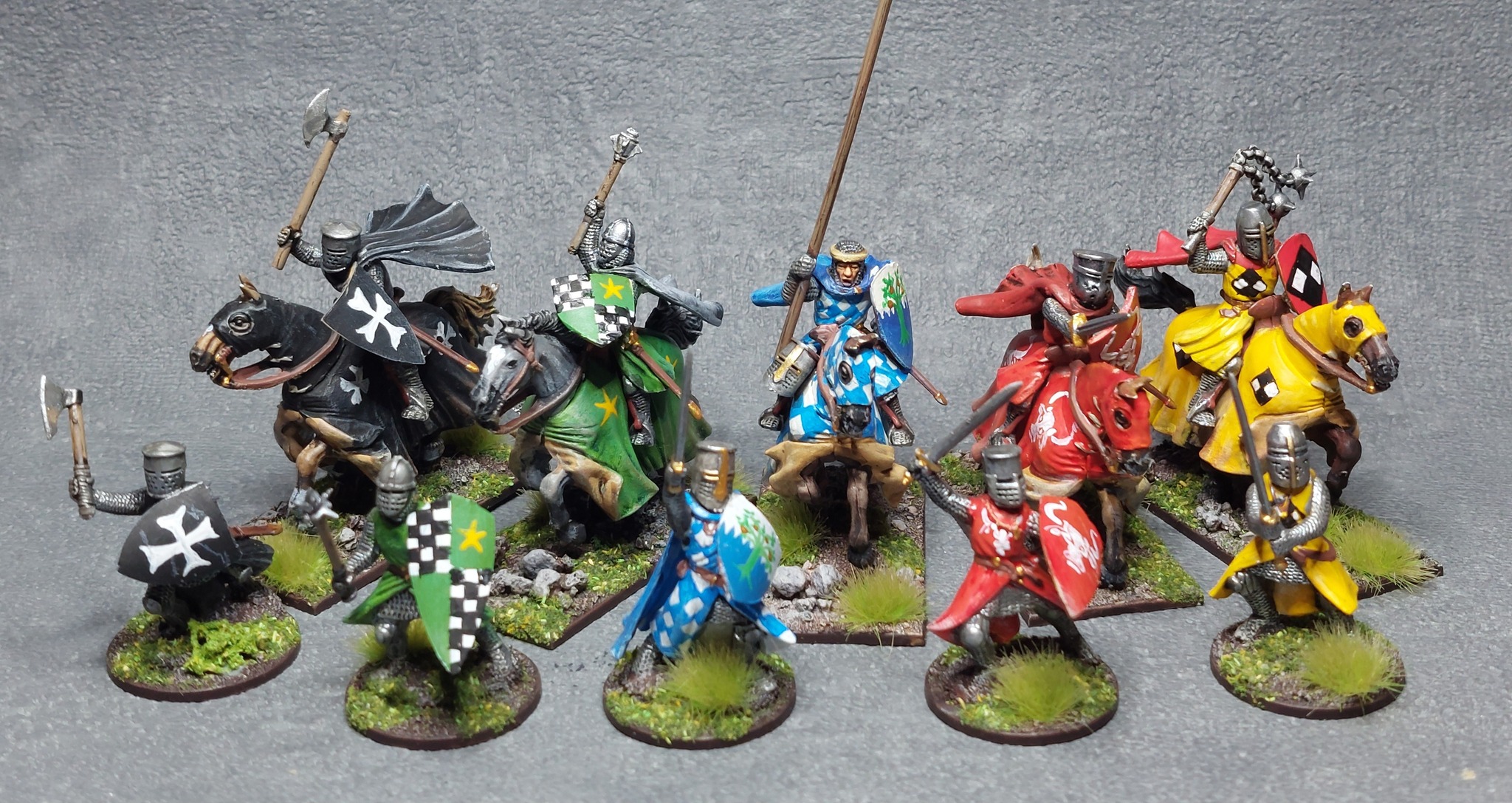
Fireforge knights


The Rules

The rules offer a mechanism with alternate unit Activation, which offers the unit the choice to perform an Action or use an Action for a reaction. Most Units have only one Action but some elite or commanding units have more. Commanding units may give additional actions to other units. When a unit Activates twice in a turn it becomes Weary and suffers from die roll penalties. 

Actions include Moving, Combat, Defending, Commanding or using an Ability. 

Units come in types (Knights, Spearmen, Archers for example) and classes (Veteran, Regular, Irregular and Green). Type determines their standard and optional equipment and class determines their stats and possible Abilities. 

Of course combat is the gist of any wargame. So how does that pan out? 

The Combat mechanism is pretty complicated and is explained on the QRS by a 11-step flow chart. In itself this is not unexpected in a skirmish system with a high degree of figure individuality. 

In short, after the conditions for entering combat are met the attacker rolls for Charging distance (which may win or lose him an Attack die), makes contact and rolls Attack dice. The Defender has decided to use an Action in Defence or not, rolls Defence dice, adds possible Action modifiers, rolls Shield rolls (a kind of extra Save) for failed Defence rolls and when applicable executes his Defence Action. Both groups then move away from each other while the loser may be Forced back further and may have to make Morale checks. You get the idea why a flow-chart would come in handy...

But there are some surprising contrasts in combat. While the combat mechanism in itself is complex, the rest of combat is extremely simplified. 

For example; when a figure loses its last Health Point it is dead. But losing 1 of several does not cause any effects. The wound is simply lost. There is no "Wounded" condition. 

While Line-of-Sight is a condition for a Charge, units have a field of sight of 360 degrees. So attacking someone from behind or in a flank has no influence whatsoever. 

It was not what I expected from a skirmish game of some granularity, especially since figures and characters can be highly individualized. Such granularity is present in some places but completely absent in others. 

Some aspects of the game seem overly complex. The game uses 8 different counters to indicate that a unit has done or experienced something. But as far as I can see, Broken, Shocked, Weary and Defend are the only ones with any specific effect. The other four could have been simply "Activated" counters. This results in a LOT of counters on the table (although you could play them on the unit card) and a lot of rummaging around for the right counter.  

The how's, why's and consequences of Morale checks (made to benefit from a Command or as a Reaction to something scary) are complex as well. Being spread out over three chapters doesn't make it any easier to grasp but there are also two different Morale consequences, Broken and Shocked, that are caused by different things and have completely different effects. At the same time, Shocked units might become Broken but not the other way around.  
So what is good? 

The game is obviously very carefully and lovingly made and the book and the rules show this. Production value of the book is excellent. 

Although several expansions have already been published the game is very complete in its own right. This is a well laid-out ruleset which includes historical background, complete army lists, scenarios, terrain tips and lots of possibility to flesh out your army with all kinds of individual traits and Abilities. There is even an army list for Robin Hood and his Merry Men as well as stats for several historical figures to feature in your games.  

The rules offer you a relatively quick-playing and classic war game which can yield clear and bloody results but may also give you tense to-and-fro battles. The fact that Commanders actually have a Commanding function in the game definitely is a good thing. 

And if you don't already own a medieval 28mm collection the game is supported by the Footsore range of figures, sculpted by the magnificent Paul Hicks. 

What could be better? 

As rules mechanisms go, this one is a bit of mixed bag. Maneuvering and getting into combat or range is a simple affair, but the actual combat is a very complicated procedure which ultimately produces very simple results: some figures die, a mutual move backwards and a possible Morale result. Which makes it hard to determine what is gained by the complexity when it IS there.  

Some choices are puzzling. For example: why is a Shield roll a separate Save while Armour is included in the figure's stats? Why, in what is after all a relatively complex skirmish game, are there no field-of-vision of rear- or flank attack options so maneuvering would be much more interesting? I would gladly exchange the complicated combat sequence for more challenging maneuvering options. And why not have both? This is a skirmish game afer all. 

Keeping track of all the different actions and their consequences with the numerous counters can be a laborious and cluttery affair.

Rules, especially the Morale rules, are not confined to the Morale chapter but are rather randomly spread out over several chapters, making them not only hard to find but also making it difficult to grasp how they work together. 

Perry trumpeter and Fireforge knight

Conclusion

The Barons' War offers a good and classic medieval skirmish game. It is not innovative or as challenging as it might have been but it is well made and very well supported. There are others like it (like Ospreys Outremer: Faith and Blood) but the Barons' War does its job well.   


Tuesday, April 30, 2019

Spectre Operations: a review of the 2nd edition


When playing a modern wargaming ruleset my impression always is that the bar for realism is raised just that much higher. After all, while we must always assume stuff when playing historical games (and the further back in time, the more assumptions we need) we can see and know modern warfare from the news, the Internet and, if we know such people, from conversations with veterans and active military personnel. So even when we have not served in active military duty, it just takes that bit more to “feel right” when playing a modern wargame.


When trying to achieve this, the first pit fall for the game designer is to over-detail things and end up with a hyper-realistic but unplayable ruleset of daunting complexity and glacial playing speed. It takes quite some skill and creativity on the part of the designer to avoid this and still come up with a game that answers to our demands for realism and offers a great game at the same time. Spectre Operations is a skirmish ruleset that strives for this. Having reached its second edition recently, I thought it time for a more thorough review. 


Context

Spectre is a skirmish game on a 1-on-1 figure scale set in the present day (which means from the Cold War days onwards to the near future). So the game supports and features the most modern weapons, equipment, vehicles and tactics. Think mini-drones, heat-sensitive gunsights and realtime battlefield communications. All of this of course existing alongside older technology that should also function in the game.

It is obviously also meant to play current conflicts, some of them even going on at this moment. This, I know, is not for everyone, but this review will not address that aspect of the game. I will assume that everybody who wants to play –or plays- Spectre has no problem with that.

Spectre works best when playing scenarios with mission objectives. As it should, since the usual wargaming standard of “pitched battle to the death” rarely features on the real battlefield.


Spectre also assumes that the defining aspect of the modern warrior is his or her training and experience. Troops are divided in quality classes (Levels) ranging from untrained civilians to elite special forces troops. Troop level determines skills, but also generally available weapons and equipment, reactions to events and certain types of behavior. For example, Untrained troops have better morale when operating in units of 10 or more and Elite troops do not have to adhere to Unit Cohesion and may operate individually.

Finally, available actions are severely influenced by Commands given before the "real"action phases. Whether troops are Alert (aware of imminent action) or Unalert (aware of possible action, but not specifically) greatly influences possible commands and actions. 

Mechanics
Spectre is turn based, each turn divided into phases that define a moment to make decisions, take actions or suffer the consequences of those actions. Turns are repeated until the victory conditions of the scenario played are met and the scenario ends. Phases include Initiative, Commands, Movement & Tactical actions and Combat (Ranged- and then Close-) 

Actions and their success are determined by rolling a D6 against a skill number. Skills include things like shooting, agility and command. Environment and circumstances usually cause modifiers to be added or subtracted.


Turn phases
In the first phase Initiative is determined by a die roll plus the highest Command value in each force minus Suppression effects. The highest score starts each phase of that turn. 

The role of commanders and/or highly trained troops comes into play through the second phase of the turn; the Command phase. In this phase Commanders may issue orders to troops they can communicate with if they can test successfully for Command. This enables larger numbers of troops to take special actions in the phases to come, like Overwatch fire (during the opponents movement phase), breaking up squads into smaller squads, Rallying or scanning for hidden stuff.

Players may move their troops in Initiative order and may perform Tactical actions before or after movement like running, sneaking, breaching doors or whatever seems fitting given the situation or scenario. And all these things might be interrupted or enhanced by Command driven actions.

Finally troops may combat by shooting, throwing grenades and fighting melee (in that order). The shoot system is an opposed die roll of Shooting skill plus die vs Defence plus die. Models can be killed instantly or become wounded and more or less incapacitated. This is determined by a roll on a table.  


Virtually any kind of weapon used by Man can be handled by the weapon lists. However this is elegantly done by reducing any weapon to a small number of stats: range, lethality and one or two special rules like Rapid Fire (more shots per salvo) and such.

All kinds of actions can be tested by using the stats given to each figure. Command is used by tests of willpower for example, while Agility is used when performing physical tasks. This prevents the need for extensive skill tables and such and results in an elegantly simple mechanism that can tackle virtually anything.

Suppression
Units gain Suppression points when their members are being shot at. As soon as a Force's point total equals its commanders' Command skill the unit must test against that Command skill. Failure will result in a higher Suppression Level. This has an enormous influence on the game. First, the Level of your units' Suppression counts against your Initiative roll for the entire next turn. Second, Suppression levels severely limit the effectiveness of members of the suppressed unit, as they will lose skill points and movement when suppression levels mount. 

While Suppression points start at zero each turn, Suppression levels stay and can only be lowered by Rally Commands. They must be managed carefully as otherwise they will slowly paralyze your force and make you lose all Initiative until units are pinned or routed.  

Miscellaneous
The rules include the use of all kinds of vehicles and other equipment. Vehicles are equally simple to use, behaving like big models and having a few special rules to handle things like (un)boarding and armour.

Advanced rules are provided to represent special situations like weather conditions or covert operations. 

The 1st edition provides a point value that has been omitted from the 2nd. This might not be to everyone's taste. I understand that Spectre's website will feature a points list in time. It is no problem in my eyes since I tend to write and play scenarios and the book supports that just fine.

The book offers scenarios and how to make them as well as a chapter on modern tactics to enable the less militaristically schooled player to emulate modern warfare in the way the rules are supposed to support them. Brief and enlightening, it is a very valuable addition to the book.

The 2nd edition offers a chapter on Campaign play as well, which is new compared to the 1st edition.


Comparison 1st and 2nd edition rulebook
Both are sturdy paperbacks in full colour. The improvement in the 2nd edition however is MASSIVE.

It sports an extra 40 pages compared to its predecessor and when comparing them the numerous examples and diagrams of play immediately stand out. These were sorely missing in the first book and they are invaluable for making the game more accessible to new players and clarifying the rules. In my opinion the best of the improvements, but not the only one.


The book's sequence now follows more logically the sequence in which one needs the rules to play a game. And there is an Index! Only one page, but nevertheless it was missing from the 1st edition.

The Suppression rules have been completely overhauled. In the 1st edition Suppression was an individual score that influenced the units. Spectre had no equivalent for a Morale/Break test of sorts but oddly I never missed that. Terrified troops "just" being immobilized instead of magically fleeing the table perfectly fitted the scale of the game. This did however require some bookkeeping and Suppression counters or dice all over the table that are no longer needed now.

Finally several rule texts have been cleared up. For example, the 1st edition was somewhat
ambiguous in whether you could perform a tactial action only before or after movement or during as well. This has been clarified quite well. Spectre obviously has taken the feedback from its fans to heart!


What is good?
Spectre is an accessible game, quick playing and able to handle (but not needing) quite large numbers of miniatures and vehicles. It now has an excellent rulebook to support it. It has a very flexible game mechanism that enables it to do anything one would expect to encounter on the modern battlefield.

This results in an immersive tabletop wargame that plays like one feels a modern engagement should play out on a wargames table. Playing time could be anything from an hour up to a day depending on how big you want your game. It scales perfectly up or down.

It covers all known protagonists of the current age as well as all the weapons one might wish to use in a game.

Last but not least the ruleset is supported by one of the best 28mm modern miniatures ranges on the market at this time: Spectre Miniatures. There are of course other producers for this period, but even if you choose to limit yourself to Spectre Miniatures you will be painting and collecting to your heart's content for quite a while.


What could be better?
Well, not much. The Index could be more comprehensive. There could have been a point system for those who want that. Mere details really.

Conclusion
If you want to play Modern Day wargames, buy and play this. It is certainly worth your time and money.

NB: Spectre Miniatures has announced it wil cease supporting Spectre Operations as a ruleset, since it was licensed from its author and that license will expire soon. The author has made it known he is working on a successor ruleset under the working title of Assymmetric Warfare. I refer to the Facebook group for news.  


Saturday, March 24, 2018

Conan 3D the Board- pardon the tabletop wargame

As a tabletop wargamer I have been toying with the idea to translate Conan to the tabletop with as little change as possible. I suspected it might yield a quite decent skirmish game that way. And it would look even better on a 3D tabletop! 


When replacing the board with a 3D environment one needs to replace the board’s funcionalities with environmental rules. Here's what I have thought up:

Speed & Movement
The figures’ speed is their Movement factor combined with the board’s areas. I don’t want to change anything in the use of the dashboards so the changes must happen in the translation from board to tabletop.


This is best accomplished by translating the Move factors to fixed Move distances on the tabletop. An average board area is about 5” across so this seems a good standard distance. I use CDs cut in half as pre-made rulers during play to avoid measuring tapes and such.

1 Movement Point equals a CDs diameter. 

Proximity
In the board game this is facilitated by the board areas. Figures can interact with all figures and objects in the same area and are Hindered by them.


Using similar distances as in Movement figures may interact with and are Hindered by all figures and objects within 5”/can be covered by a CD’s disk.

Measurements are taken from base edge to base edge. This gives large creatures a longer Range, which does not seem unreasonable or undesirable. When using very large creatures measurements are taken from the right front limb or edge, whatever is present.

Line of sight


This seems easy, as physical terrain pieces will block line of sight instead of the LOS dots. In the boardgame terrain is either Blocking or not. Not wanting to add any fundamental changes to the game this means that no rules are necessary regarding partial cover and such.


Since the dots are now replaced by the figures’ relative position to each other, LOS will become more complex and influential. 

Test games

We used The Amazon's Dragon from the Mythic Battles/Conan crossover set as a test scenario because the terrain could be easily represented with my own collection. It played perfectly and retained the exact same feel as the boardgame but with more freedom of movement. The scenario is a real cliffhanger so it went undecided in both test games up until the last turn. 

Care needs to be taken that the table doesn't get too big as Conan games need to be finished in a set number of turns and distances need to be covered in about the same time on the tabletop as on the board. Apart from that (and building copious amounts of terrain) it all went smoothly. 

So in building more terrain for this game there is even more fun to be had from this great game!