Showing posts with label skirmish. Show all posts

Sunday, March 26, 2023

Review The Barons' War by Footsore Miniatures

The Barons' War is a 28mm medieval skirmish ruleset for a tabletop wargame by Andy Hobday and is published by Footsore Games. With a few games under my belt I felt ready for a review. 

Rulebook and counters


The game was either followed up by several medieval figures Kickstarters by Footsore Miniatures or caused by them. I missed the exact order of events but in any case this means that the game is accompanied by the Footsore range of very good miniatures for 13th century England. But these miniatures are not my objective; the ruleset is. What about it? 

The Looks

The book is an small (A5) full colour booklet of some 135 pages. It is beautifully illustrated and filled with excellently explanatory diagrams and pictures, a lot of which feature Footsore's beautiful 28mm figures for the game. Due to its small size the font is a bit small as well and the pages are so densely filled with text that my usual ploy to cut off the back and give the book a spiral binding was unfortunately not an option. This leaves me with a small rulebook that will snap shut as soon as you let go of it and needs good light to be legible. Of course that might be my age :)  

The layout shows a comprehensive and logical sequence of chapters in which the game is introduced, shows what is needed and roughly follows the sequence a game turn would take. There are chapters on army structure (your "Retinue"), the Game Round, Movement, Combat, Morale, building your Retinue and so on. 

This logical sequencing is not always mirrored in the contents of the chapters however. For example the rules for Morale are spread out over the chapters Game Round, Combat and Morale, which does not seem a logical choice given the fact there is a Morale chapter where all of them should have been found.  

The book contains extensive lists of troop types and characters, scenarios and tips for scenarios and two lists with all kinds of Abilities with lots of choice to give your units that final touch of individuality. There are two lists because the Abilities come in two flavors: Inherent (fixed to specific troop types) and optional (which can be bought for points). This is not immediately clear so it took me a while to track down some Abilities during play. 

The book also includes a QRS and a scannable/printable page for the counters used in the game. The counters can also be bought separately by the way, printed on mdf.
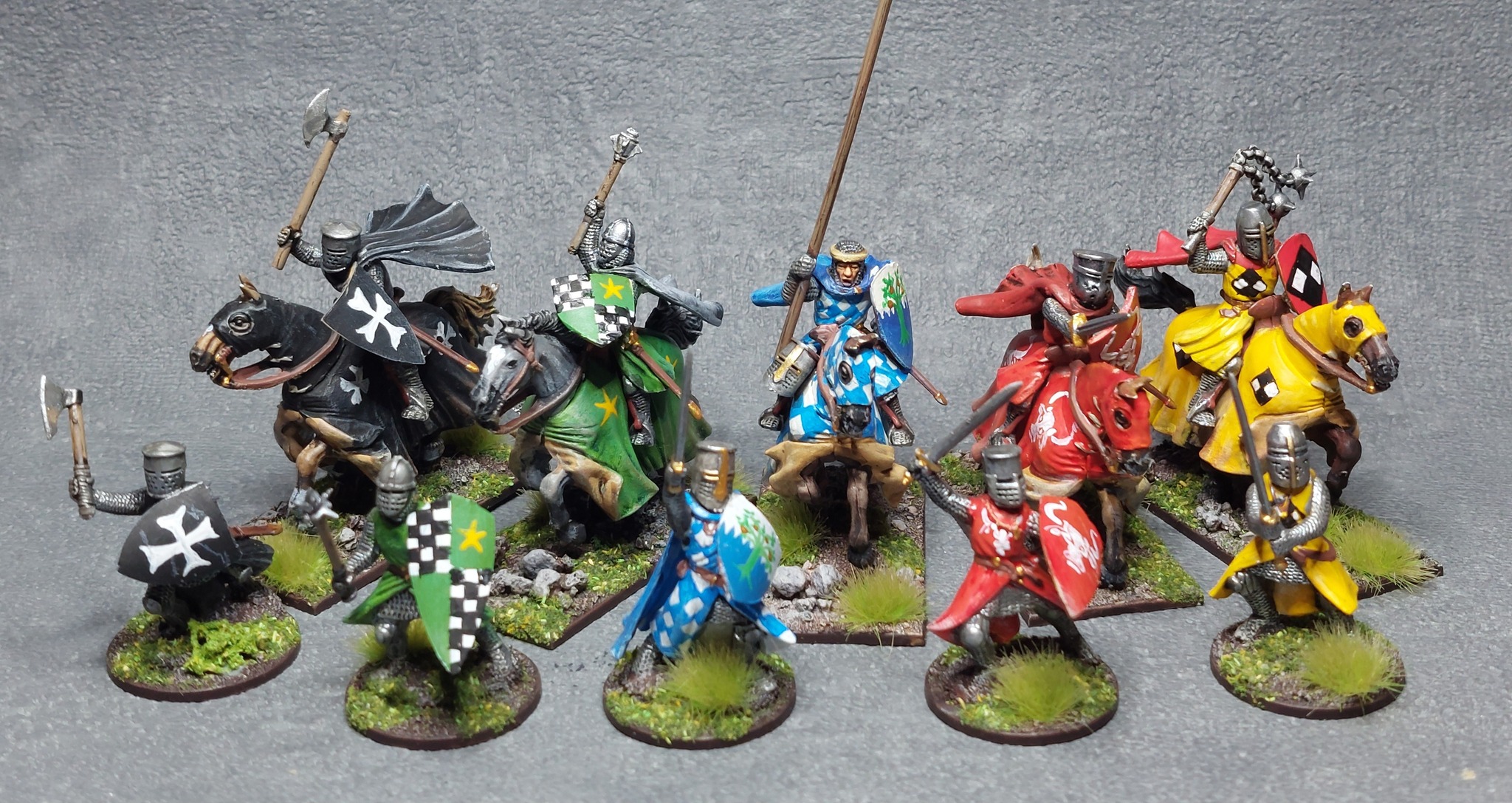
Fireforge knights


The Rules

The rules offer a mechanism with alternate unit Activation, which offers the unit the choice to perform an Action or use an Action for a reaction. Most Units have only one Action but some elite or commanding units have more. Commanding units may give additional actions to other units. When a unit Activates twice in a turn it becomes Weary and suffers from die roll penalties. 

Actions include Moving, Combat, Defending, Commanding or using an Ability. 

Units come in types (Knights, Spearmen, Archers for example) and classes (Veteran, Regular, Irregular and Green). Type determines their standard and optional equipment and class determines their stats and possible Abilities. 

Of course combat is the gist of any wargame. So how does that pan out? 

The Combat mechanism is pretty complicated and is explained on the QRS by a 11-step flow chart. In itself this is not unexpected in a skirmish system with a high degree of figure individuality. 

In short, after the conditions for entering combat are met the attacker rolls for Charging distance (which may win or lose him an Attack die), makes contact and rolls Attack dice. The Defender has decided to use an Action in Defence or not, rolls Defence dice, adds possible Action modifiers, rolls Shield rolls (a kind of extra Save) for failed Defence rolls and when applicable executes his Defence Action. Both groups then move away from each other while the loser may be Forced back further and may have to make Morale checks. You get the idea why a flow-chart would come in handy...

But there are some surprising contrasts in combat. While the combat mechanism in itself is complex, the rest of combat is extremely simplified. 

For example; when a figure loses its last Health Point it is dead. But losing 1 of several does not cause any effects. The wound is simply lost. There is no "Wounded" condition. 

While Line-of-Sight is a condition for a Charge, units have a field of sight of 360 degrees. So attacking someone from behind or in a flank has no influence whatsoever. 

It was not what I expected from a skirmish game of some granularity, especially since figures and characters can be highly individualized. Such granularity is present in some places but completely absent in others. 

Some aspects of the game seem overly complex. The game uses 8 different counters to indicate that a unit has done or experienced something. But as far as I can see, Broken, Shocked, Weary and Defend are the only ones with any specific effect. The other four could have been simply "Activated" counters. This results in a LOT of counters on the table (although you could play them on the unit card) and a lot of rummaging around for the right counter.  

The how's, why's and consequences of Morale checks (made to benefit from a Command or as a Reaction to something scary) are complex as well. Being spread out over three chapters doesn't make it any easier to grasp but there are also two different Morale consequences, Broken and Shocked, that are caused by different things and have completely different effects. At the same time, Shocked units might become Broken but not the other way around.  
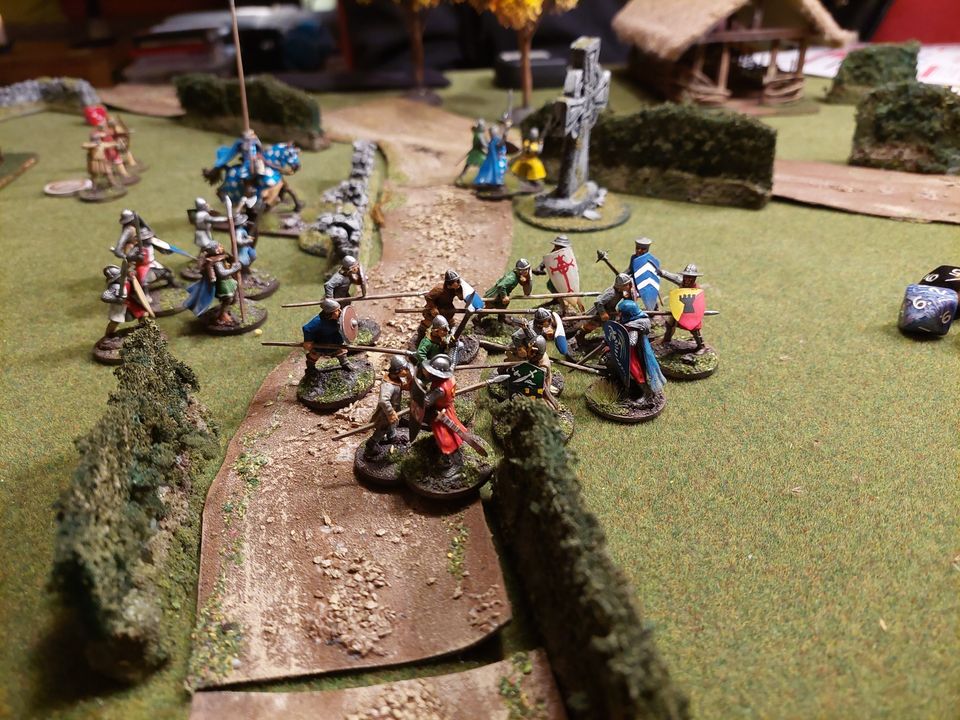
So what is good? 

The game is obviously very carefully and lovingly made and the book and the rules show this. Production value of the book is excellent. 

Although several expansions have already been published the game is very complete in its own right. This is a well laid-out ruleset which includes historical background, complete army lists, scenarios, terrain tips and lots of possibility to flesh out your army with all kinds of individual traits and Abilities. There is even an army list for Robin Hood and his Merry Men as well as stats for several historical figures to feature in your games.  

The rules offer you a relatively quick-playing and classic war game which can yield clear and bloody results but may also give you tense to-and-fro battles. The fact that Commanders actually have a Commanding function in the game definitely is a good thing. 

And if you don't already own a medieval 28mm collection the game is supported by the Footsore range of figures, sculpted by the magnificent Paul Hicks. 

What could be better? 

As rules mechanisms go, this one is a bit of mixed bag. Maneuvering and getting into combat or range is a simple affair, but the actual combat is a very complicated procedure which ultimately produces very simple results: some figures die, a mutual move backwards and a possible Morale result. Which makes it hard to determine what is gained by the complexity when it IS there.  

Some choices are puzzling. For example: why is a Shield roll a separate Save while Armour is included in the figure's stats? Why, in what is after all a relatively complex skirmish game, are there no field-of-vision of rear- or flank attack options so maneuvering would be much more interesting? I would gladly exchange the complicated combat sequence for more challenging maneuvering options. And why not have both? This is a skirmish game afer all. 

Keeping track of all the different actions and their consequences with the numerous counters can be a laborious and cluttery affair.

Rules, especially the Morale rules, are not confined to the Morale chapter but are rather randomly spread out over several chapters, making them not only hard to find but also making it difficult to grasp how they work together. 

Perry trumpeter and Fireforge knight

Conclusion

The Barons' War offers a good and classic medieval skirmish game. It is not innovative or as challenging as it might have been but it is well made and very well supported. There are others like it (like Ospreys Outremer: Faith and Blood) but the Barons' War does its job well.   


Sunday, January 16, 2022

The Silver Bayonet: A Wargame of Napoleonic Gothic Horror review

I never would have thought it possible that I would ever wargame Napoleonics. EVERYBODY and his dog already did that. 

And then Joseph McCullough wrote The Silver Bayonet and I was done for. So I scavenged some 28mm Napoleonics leftovers from mates here and there (I already had monsters and terrain) painted them and played my first game. 


What kinda game is this anyway?
The Silver Bayonet is a skirmish wargame. Units are small, at most an officer and 7 figures, moving individually. It's setting is Gothic Horror, which means it happens somewhere between the 16th and the 19th century and is about ghosts, vampires and other classical monsters lurking in deep forests or crumbling ruins. It's Napoleonic, so very colourful. But in the dark…


So French Chasseurs and British Britse Riflemen chasing each other and all kinds of monsters all over Europe. The many long wars attracted all kinds of supernatural vermin and every European nation which wanted to be in the Big League raised a specialist unit to combat that. So far the fluff.

Looks ain't everything
The book is a decent hardback of 160 pages. It could have been more if it had been up to me, because the font is a bit small. Then again, not everyone is over 50…

The book looks like an 18th century journal (complete with atmospheric bloodstains) and this has been extended into the book's interior with a lot of text and some black-and-white illustrations. There are no colour pictures or explanatory diagrams, although I must say I haven't missed them. 

To me, the book looks a bit dull. But it does what it is supposed to do, which is laying out and explaining the rules in a clear and accessible way. The book has a clear and good index, which is a big plus for me. I advise to download some aids from the official Facebook page, like a QRS and a Bestiary which lists all the monsters and to put some bookmarks in the book. There is an Excel unit builder in the Files section as well. This will help you find things without leafing through the book too much. 

Besides the rules the book includes 10 scenario’s, 4 solo scenario’s (as well as solo rules, obviously) a Campaign system and tips to write your own scenario's. Very handy. And of course lists for troops to include in your unit and a list for monsters. 


A scenario is usually won by driving off your opponent and/or investigating clues on the table, killing monsters as you go along. Or running for your life from them.... 

The clues are revealed with the help of playing cards. Simple numbered counters would have worked equally well, but wouldn't have that 18th century feel, would they? 
Scenarios are won on points, gained by killing opponent's, investigating clues and killing monsters. 

Rules and novelties
One or more players each command a unit to battle an enemy unit and/or monsters. The monsters are controlled by the game and react "programmed". Like automatons. They appear on double Initiative rolls in our games. Officially only on a double 1, but we thought the more the better and used any double. So far we haven't rolled any double 1's for Initiative btw, so the official rulings leave you largely devoid of monsters. And that can't be right. Double 20's for Initiative trigger Special Events. 


Turn sequence is a kind of IGO-UGO where the Initiative winner of that turn moves half his unit first, then monsters Activate, then the entire enemy unit and then the remaining part of the Initiative winner's unit. So losing Initiative means the monsters may Activate before you do. Which is bad. 

Activating a figure means the figure may Move and perform an Action, or may Load instead of Move and perform an Action. So you can shoot more. Which is good, right? 

Mr McCullough replaced his usual D20s by D10s, which leads to less random results, which is also good. 

Activated figures roll for Tests so succeed in things like hitting someone with a musket or melee weapon. They always roll two dice; a blue Skill Die and a red Power Die plus a Skill value. The added total is the result and in case of a hit the Power Die determines damage. Elegantly simple. 

I struggle with the Fate Pool, however. At the start of the game you get 2 blue Skill Dice, 2 red Power dice and 1 black Monster die. You can use each to pick an option and then discard them. For example you reroll a Skill, Power or Monster roll result or cancel all damage from an attack. Using these options wisely can make a lot of difference in the game.

But. Instead of having piles of coloured dice lying around a simple check list works just as well. I thought using all kinds of specifically coloured dice a hassle and used a check list.   

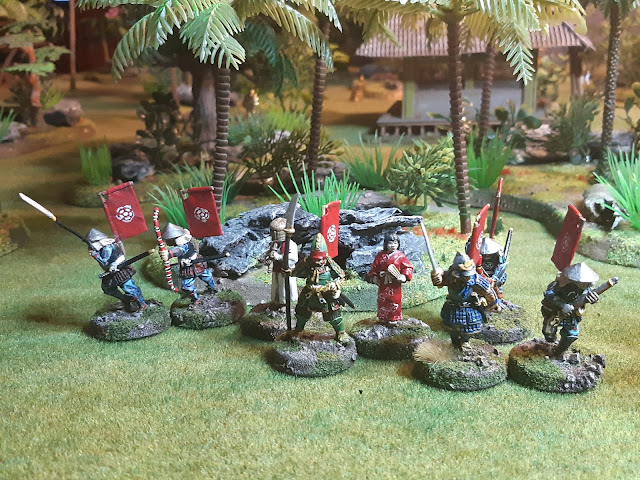
My Japanese unit. We do not use different stats, but substitute bows for rifles and teppo for muskets. 

Another, so far underused by us but interesting item is the reaction to being attacked. If the target figure survives the attack, it can either respond in kind by shooting or meleeing back or can duck back into cover. This simple reaction mechanism prevents an entire enemy unit taking pot shots at your figure until it is dead. 

Conclusion

All in all this resulted in a very enjoyable, quick-playing and interesting game with a good mix of maneuvering, shooting, Melee and investigating clues. And battling or running from monsters. Those can really make or break your day. You might encounter a monster that you have no defence against and even if you do, they are dangerous. But they cause interesting problems and dilemmas and make the game a bigger challenge. 

This is a "shooty" game. Muskets and rifles cover the larger part of the square meter table we use, even if you have to reload after each shot. However, shots are rarely instantly lethal and the duck back reaction choice should prevent your figures from getting killed too quickly. Standing your ground and engaging in musketry is usually not a wise choice...

Use your Fate Pool dice wisely (and not just to hit someone) as it can save your life later in a game and make a big difference in the outcome.  

Rules as written do not produce a lot of monsters but that is easily fixed by introducing monsters on any double Initiative roll. 

Although the game is intended to be Napoleonic, any musket-wielding era or setting would do. I greatly enjoy playing it in mid-19th century Japan, for example. But the pike & shot era or a pirate background would work equally well. Personally I greatly enjoy my Japanese setting. 

The number of figures needed is larger than you might think. Besides a minimum of 8 figures for your unit you will need a few dozen monsters, bandits and cultists. Because any monster can turn up in any game, besides the ones requested by the scenario.  

With minor adaptations, heartily enjoyed and recommended! 

The Silver Bayonet: A Wargame of Napoleonic Gothic Horror
Joseph McCullough, Osprey Games 2021


Saturday, November 21, 2020

Danger Close modern skirmish rules: a review

Writing a wargaming ruleset is in itself not very difficult. Writing a good one is. Writing a compact good ruleset is downright hard. So when I came upon the 2nd version of Empress Miniatures' rules and found out they were all of 4 pages (vehicle stat charts excluded) my curiosity was piqued! 


How does it look?

Danger Close can be bought as a 4-page booklet or a PDF. I bought the latter and also added the (free!) vehicle stat charts as well as a blank one to add your own. 

The pages are densely packed with text and tables. To my amazement the rules essentially cover only 2 pages. The next two are used to display the vehicle rules which are a variation on the infantry rules of page 1 and 2. Given the very limited size of this ruleset it is no surprise that it lacks any pictures or explanatory diagrams. 

System & mechanics

DC is a (kind of) alternate turn skirmish system meant for games with a few dozen figures and some vehicles. Turn sequence is determined by troop quality, the best activating first. Troop quality also determines how many figures you may Activate in your turn as well as maximizes the number of actions a figure has per activation, the best having more actions. So a figure might perform 2 to 5 actions per activation and can be activated once per turn. Finally, troop quality gives modifiers based on the difference in quality between opponents in spotting your opponents, shooting in a firefight or combat. So better troops move sooner, can do more and are more effective in combat and firefights.  All based on one stat. Very elegant. 


When your number of figures have exhausted their actions, it is your opponent's turn. And so on, until all figures have been activated and a new turn starts. 

Shooting requires Spotting first. Once having spotted your target, you can shoot at it, using a D20 +/-modifiers based on the situation and trying to beat the minimum score. A hit will result in an injury (roll a second D20) or a miss, which still causes stress. 

Stress is the currency of Morale in this game. The game knows only two Morale classes: Regular and Insurgent. Figures acquire Stress from being fired upon. All Stressed figures must make a test before being actiovated and might end up being limited or even surrendering. There are rules added for radios, boobytraps and Casevac, 

The vehicles function about the same as a figure, but with different results for spotting and getting damaged. The vehicle rules include aircraft, AT weapons and AA weapons. 

The vehicle stat charts include modern vehicles for the US, UK, Russia, China, France and Germany, as well as a chart with modern helicopters and a Vietnam 65-75 vehicle chart. 

How does it play? 

When one expects a brief ruleset to result in a quick game, DC will surprise you. A small squad versus squad game actually took us a few hours. While Activating is straightforward and gets figures moving around the table pretty quickly, especially shooting takes up a lot of time. Not just because it is a bit labour-intensive (roll (or at least calculate) for spot +/- modifiers, roll for shoot +/- modifiers, roll for injury) but because it is quite hard to hit something! 

Since the target number is 17+ and the best positive modifier is a +3 you still need a 14+ to hit. So most shots miss and only result in Stress. We had one soldier standing in the open acquiring 12 Stress from getting shot at, failing his test, duck away and start without Stress all over again next turn! That way it takes a while to get decisive results. 

This may be a conscious choice (it usually takes an average few hundred bullets to kill an enemy these days) but it might not be everybody's idea of a fun game. 

Morale checks are quick and easy but tend to give temporary results. There is no gradual deterioration of a force through loss of Morale. 

You have to fill in a number of things that are not explained or expanded upon because of the briefness of the ruleset. Definitions of things like Overwatch, "obscured" and range (measuring from what to what?) are not included. How to place terrain, muster your forces or write a scenario are skills you have to bring yourself. 

What is good? 

For compactness and price this game wins everything hands down. The ruleset is clear and brief and logically structured. Being essentially only 2 pages long, it does not need an index. Just turn the page. 

Activation and Morale are quick and easy and the quality difference between troops is done very elegantly. There is hardly any bookkeeping needed besides Stress, injuries and Overwatch. 

What could be better? 

The shooting sequence is a bit laborious and ineffective. This made our game last a while. This might be realistic, but perhaps not to everyone's taste. 

This game works with modifiers. A lot of them. Because of the 4-pages format modifiers are grouped together by impact. So for example all reasons to apply a +2 to shooting are grouped together in 1 line. This makes it a bit hard to find a specific reason sometimes. However, after a few games these things will probably get stuck in your memory.  

There is another caveat. This set is so compact that it only gives rules and explains nothing. This can be left out assuming the player is familiar with the way a wargame works, how Moves are measured for example or what something like "obscured" is supposed to mean. There are no scenarios or rules to set up a table. Al these things are absolutely no problem for experienced players but this might make the set less suitable for a beginner. 

A quote from a regular player: 

"That’s a really fair review! I’ve been using the rules for a while (unsurprising as my regular opponent is Paul from Empress  ) and I’ve come to really like them. The key, I find, is to regard them as a tool kit you can build upon as you want. For example, I’ve used them with up to 100 figures but initiating at “section” rather than individual figure level. If you want a faster game try adjusting the number required to hit downwards? It’s your game so adjust as suits you? They key thing is to enjoy what you’re doing!"

Danger Close: Modern skirmish wargame rules, version 2
4 pages (+ 6 pages of vehicle stats)
Empress Miniatures

See also https://empress-miniatures.forumotion.com/


Saturday, August 31, 2019

Asset Acquisition: A Spectre Operations scenario


Asset Acquisition

The theme
A Special Forces team is tasked with acquiring an unknown asset or –when deemed impossible- denying the asset to the enemy


The scene
A cleared spot in the Colombian jungle halfway surrounded by rocky outcrops and dense forest. The centre of the table holds the Asset and a camp erected around it with tents, cars or a truck and tools.  Lots of equipment, barrels and crates


Victory conditions.
The attacker needs to secure the asset or, when impossible, destroy it. The attacker needs to extract at least 5 operatives.
The defender needs to prevent this.


Deployment
The defender sets up first. The cartel elements are Unalert and set up in the camp. The professionals deploy as guards around the camp (may be hidden) and are Alert.
The attacker may choose his route of attack.

Defender:
·         6 Professionals (Alert, bodyarmour, carbines/laser sights and sidearms, frag grenades, close combat weapon) including a team Commander
·         20 cartel gangsters including 2 team commanders. Militia, Unalert and armed as shown + close combat weapon.
·         1 Force commander (Elite, Professional, SMG and sidearm)
·         4 Civilians, unarmed, unalert

Attacker:
8 Elites, including a team commander (Alert, bodyarmour, carbines/laser sights/red dot, silencers, sidearm, close combat weapon, flash and frag grenades). One assigned man carries enough C4 to destroy the Asset.


The rules
Optional: nighttime conditions. Consider the camp as if in daylight. Everything outside the perimeter is night.


Destroying the Asset
Applying the C4 is a Command (no roll). The action takes the entire turn and is only finished at the start of the next turn. The operative sets a timer device for 1-4 turns.
The C4 blast will cause a Lethality 4 hit to all targets in a 12”radius and destroy the Asset.
  
How it played out the first time

We found out we needed some additional rules for random moving guards and specific cover around the saucer craft. The jungle terrain needs some more structuring. And the craft really needs to be placed in the center of the table but apart from that the scenario worked fine. The SpecOps blew up the craft but lost two men in the blast. The scientists escaped. Perhaps their capture should be a secondary objective.

This scenario is the first to fit in my Mythos Wars project hence the use of a 70 years old Nazi saucercraft as The Asset :)

Friday, September 7, 2018

Last Days: Zombie Apocalypse: Houseruling suggestions.

As you might have read in my review of LD:ZA I wasn't very happy with how the rules turned out. But they did have some very attractive points. 

So, like with a sexy sportscar that has quirky handling but looks oh so lovely I decided to collect, develop and test a number of houserules to solve the games most impactful (in my eyes at least) shortcomings.


Each houserule should provide a more interesting dilemma than the original rule and/or mitigate an effect that is undesirable for enjoyable gameplay (in my opinion at least). 

Cover

There are two types of cover:
  • Hard cover: -2 To Hit (most of the figure obscured by cover) or
  • Partial cover: -1 To Hit (most of the figure visible despite cover)

Desired effect: decrease effects of firepower. Enhance effects of tactical manoeuvring. Tested.

Movement

Prone: 
  • additional -1 To Hit (on top of existing cover modifiers) 
  • takes 1 AP to go Prone and 2 to get up. 
  • Prone Characters must spend 2 AP to crawl 1" . 
  • Going prone may obscure a character behind cover completely by laying down the figure.
  • Prone characters may fire and/or spend AP on other actions as normal.
Desired effect: decrease effects of firepower. Enhance effects of tactical manoeuvring. Tested. 

Dogs

Dogs may Run. 
Dogs may learn from Experience. 
Dogs may pick and develop Skill types from the Athletic and CQC tables. 
Dogs may pick up and move loot after acquiring the Heavy Lifter skill. They may not use any other effects of that skill. 
Dogs may learn to walk or run silently after acquiring the Stalker Skill.  

Desired effect: get a dog and enjoy it! Untested. 

Lock & Load

When firing in Lock and Load modus during your opponent's Move you get a -1 additional To Hit modifier for each shot fired with that Action. 

The L&L counter is then not removed but flipped over and left on the table. The character may not fire again in either the Move-,  Shoot- or Menace Phase that follows.

Firing in L&L modus in the Shooting phase by a character with an unflipped L&L counter gains the character a +1 To Hit. Then Flip the counter and leave it on the table. The character may not fire again in the Menace phase. 


Firing in L&L modus in the Menace phase by a character with an unflipped L&L counter gains the character a +1 To Hit. Then remove the counter. 

Desired effect: Decrease effects of firepower. Tested. 

Zombies
Use this rule instead of the zombie specifications in the scenarios. 

Zombies appear at the start of the game or during the game.

At the start of the game place 1 + D6 zombies per player on the table. Each player places one zombie alternately anywhere on the table until all are placed. They may not be placed in a deployment zone.

Noise counters generate zombies. Roll 1D6 per noise counter. On a 4+ a zombie appears 8" from the noise counter in a random direction. Use a scatter die of some sort and skip the noise counter modifiers. 

When Downed by a zombie, do not roll on the Injury Table but apply an automatic Infected Result (11). First Aid has no effect here. 

Zombies actions for (in that order)
·         Nearest survivor in LOS within 12"
·         Loudest noise within 12" (Closest when tied) 
·         Loudest noise (Closest when tied) 
·         5" in a random direction

Zombies do not block LOS to other zombies. If they can't reach a survivor due to other zombies in the way they simply queue up.  

Desired effect:
Make zombies a tactically relevant factor in the game. Create the need for tactical manoeuvring. Tested. 

Loot

Add to the miscellaneous Actions Table: Search a house or other closed piece of scenery. 

Searching costs 2AP. Then Roll 1D6: 
  • On a 1 there will be 2 zombies inside
  • On a 2 there will be 1 zombie inside
  • On a 5-6 there will be Loot. 
A piece of scenery may be Searched only once. 

The Loot counters found in pieces of scenery count against the total number of Loot counters for that scenario. So place some on the table and leave some out to be found through Search. Once all the Loot is picked up or found, none remains. 

Desired effect: More zombies or more Loot. It's a win-win! Tested. 

Cars

It has been a while since civilization stopped and the zombies took over. So most cars will not work anymore. However, some might. 

Starting and driving a car
When trying to start a car roll a D6 for present keys. On a 6 there are still keys present. If not, the car must be hotwired. 
  • Getting into a car takes 1 AP
  • Starting a car with keys takes 1 AP. 
  • Starting a car through hotwiring takes 4 AP. 
  • The car starts on a 5+. 
  • Only one character may try to start a car or drive one in any one turn. 
  • A starting car gets 3 noise tokens on the start location. 
  • A car with running engine gets 1 per turn which follows the car. 
Characters moving in cars may move 3" per AP. Drivers may drive-and-shoot if they choose but lose control of the car on any roll of 1 (either To Hit or for Damage). 

Cars offer Hard cover to passengers. Cars never Run and never get a -1 Run modifier due to their size. 

Out of control, collisions and crashes
All characters and zombies hit by a driving car suffer a Strength 5 CQC hit. On a Damage roll of 1 the car is out of control. 

A car hit causes 1 additional Noise counter at the collision location. 

Out-of control cars move 10" in a random direction and then stall (or crash into an object on the way). All characters in a crashing car suffer a Strength 3 CQC hit. 

A crashed car will not function again. A car crash causes 5 Noise counters. On a 6 the car alarm malfunctions and starts blaring. 1 Noise counter per turn. 

Any To Hit roll on a car and its passengers of an unmodified 6 does not hit a passenger or driver but a vital part of the car instead. The car hit this way then gets out of control and will not function again. 


Desired effect: Baby you can drive my car! Untested. 

EDIT September 14th 2018: 

Tested the house rules tonight. They worked very well. The numbers of zombies increased dramatically and put an end to any static tactics we might be inclined to. So no more time to gun down your opponents and pick up the loot. Not in the least because employing terrain for cover actually made sense now and groups of zombies would surround you and wear you down.  

The new L&L rules offered a nice choice between mobility, firepower and a fast shot in your opponents move or an aimed shot in the shooting phase. 

The faster dogs made great noisemakers and zombie-killers. 

In the course of the game small groups of zombies roamed the table, slowly increasing in numbers and forming a small horde, making the table look like a small zombie apocalypse at last! 

Searching houses produced as much loot as it did zombies. We didn't get to try out a car unfortunately. 


Sunday, September 2, 2018

Last Days: Zombie Apocalypse. An Unhappy Review

Lately Osprey has increased its menu of wargames rules with the zombie variant and published Ash Barkers' Last Days: Zombie Apocalyps.


Since I am a great lover of the zombie gaming genre but good rules are few and far between I inquired after these rules, read some (positive) reviews and, encouraged, proceeded to buy and play them. This resulted in a pleasant Friday night game of about 90 minutes in excellent company. However, how did LD:ZA conduct itself?

What was good? 

LD:ZA is a pleasant looking hardcover 108 page book with full colour interior. Font is pleasant to the eyes,  The book has a fine systematic layout in the approximate order you will follow when starting a game. This will inevitably sometimes run counterclockwise to the order in which you do things but I generally was able to quickly find the required rule while leafing through during my first game. Character sheets and refuge sheets are included in the book. A 2-page Quick Reference Sheet is downloadable from the Osprey site as are the sheets.

There are some points that are less than obvious however. The Rarity number of weapons for example is the maximum number of that weapon you may have at the start of the game. It can be deducted from the rules but isn't actualy stated anywhere.

Note the difference between Skill Type and Skills. A Skill Type is an area your character may develop in. This does not actually give him any Skills at start. Actual Skills are noted under (somewhat confusingly) Special Rules. It took me some time to work that out....


The book has comicbook style artwork which does great things for the atmosphere.

Character generation
In a skirmish game I like my characters properly distinguished in skills and equipment. LD:ZA has a comprehensive character generation system in which you can quickly and easily generate a team/gang. A 100 point team will give you 6 to 8 characters and reasonable equipment. LD:ZA is set at the high point of zombie infestation and you don't start with a frying pan and a kitchen knife. The characters even have a kind of character type (like Selfish or Trained). Although this only seems to be used in combining team members in likely combinations.  Each team has a hideout that also gives benefits and can be used in scenarios.

Most characters are pre-generated. However, choosing Survivors enables you to tailor-design your team with skills and equipment you can choose yourself, which is a good balance between convenience and possibilities.

Campaign
LD:ZA has a Campaign system (which is an absolute must have in my book) that is simple enough. Loot, feats and injuries are rolled for afterwards and yield bonuses or penalties that influence future scenarios. Quite a few skills you can award your characters play no role in the game itself, but in the Campaign phase. The Campaign also develops your characters skills through earned XP.

The book includes 6 scenarios, ready to play.

Mechanics
The mechanics are well tried and simple. LD:ZA is an alternate activation IGO-UGO game where characters have Action points to be spent on actions. Downtime during play is limited that way and interrupting actions during your opponents turn can be done through Lock and Load which enables you to fire in your opponents turn.  The game has a Menace (zombie and other misery happens) Move and Shoot Phase that each start after the former has been completed.

Characters have stats for things like shooting and close combat. Action tests consist of a D6 die roll plus a stat value that must overcome a threshold to succeed (usually 7). Hits may translate into damage depending on the damage value of the weapon, the target's Endurance and a D6 roll. So there is a To Hit + To Wound sequence. Shooting and close combat are nevertheless quick affairs and easily handled.


Zombies are summoned by making noise like running or shooting. The more noise, the more zombies.

It is meant to be played on a 3x3 foot table and urban terrain. Most skirmish games require lots of terrain and this is no exception.

Where is the errata? 
It is in the Last Days official Facebook Group.

What could be better? 

There is a story somewhere
Ash Barker emphasises the narrative as an essential aspect of a good skirmish game. I agree with him fullheartedly. However using pre-generated characters and refuges somewhat diminishes this. The links between games and campaign events are a bit abstract to my taste. You can lose your refuge to zombies on a roll of a table for example. It is a shame to play such a dramatic event only in that way. I understand the reason however, since zombies would be absolutely incapable to overrun a refuge in a real game. Getting taken out by zombies should be lethal, but actually is hardly a problem. See below.

I have a feeling some opportunities were missed here.

Where do I hide? 
What makes a skirmish game interesting in my book is maneuvering figures and interacting with terrain in a tactically interesting way. This is usually prompted by the presence of ranged weapons and the need to take cover from them. So you need to maneuver for a good firing position or, lacking that, for evasion and/or close assault. A good skirmish game usually sees a lot of movement taking place within firing range to successfully evade enemy fire.

Firing ranges in LD:ZA for long-range weapons (available from the start of the game) range from 24 - 30" and thus cover most of the 3x3 table within sight. However, since any form of cover behind which you can still be seen only decreases the shooting roll with 1 point, taking cover is largely pointless. Hits are usually scored on a roll of 3-4 (Shooting skill 3-4 being average) which only rises to a 4-5 for any form of cover. Firing rates for long range weapons are initially usually 1 but rise to 2+ as soon as more equipment is found or immediately by starting with Survivors with the Double Tap Skill (may reroll Shoot or Damage rolls). So being hit in cover is quite likely and indeed happens all the time. I had three of my characters running through a field of fire behind the cover of cars the entire time and still all three were killed. In this game running is just as effective by the way (also a -1 to hit) as taking cover. The problem is you cannot shoot in that turn.

This unsurprisingly resulted in a game where the teams more or less remained in their starting zones and fired at each other. Enhancing the effects of cover would have solved this.


What is bad? 

Has anyone seen my zombie? 
You start the game with a few zombies on the table. These die quickly and easily (zombies are hit +1) and that is OK.

However, zombies are quite rare in this game. A noise counter doesn't produce a zombie but only a +1 on the zombie roll (that needs a 7). So you need 3 to 4 noise counters in one location to reasonably summon a zombie. And even then none may appear. In this game zombies seem to be outnumbered by the survivors! You will certainly not encounter a horde anytime soon.

Zombies are also rather weak in close combat. They are slower than humans (no runners here) and have a lower Close Combat stat. This wouldn't be a problem if only they were actually menacing. But even getting taken out by zombies just earns you a roll on the Campaign Injury table with a very good chance of survival. You can get infected through such a roll but being killed by a zombie has no effect on that whatsoever. I miss a narrative opportunity here.

So zombies are far from lethal. Leaving them out altogether would hardly change the game. All this kinda makes them no more than a mild annoyance in the background and the idea of a Zombie Apocalypse a bit hard to swallow to be honest. A rather fatal flaw for a zombie skirmish game in my opinion.

Overshooting things
In a game where shooting is so effective Lock and Load (the "Overwatch rule") that lets you shoot in your opponent's movement phase is obviously quite powerful. But this is compounded by the fact that having fired through Lock and Load during the Move phase (without any penalty on To Hit by the way) you can fire AGAIN during the shooting phase (again without any penalty). L&L therefore gives you twice the number of shots for just 4 AP.

And since maneuvering and taking cover doesn't make much sense, sitting tight and L&L is the obvious alternative and not even a dilemma. You can even move for 2 AP AND L&L.

The fact that multiple shots (more than 1) only cause a -1 for all consecutive shots make automatic weapons not only powerful but as accurate as a normal rifle.

In my opinion (and this is a matter of taste, I know) this contributes to the fact that LD:ZA quickly becomes a rather static shootout. This may be realistic, but not very interesting game-wise.

A dog's life
You can pick a dog as your team member. That is great! It has 8 AP (2 more than a human) and is a good close combat fighter.

However, dogs (the Animal Skill/Special Rule is in the errata) may not run, cannot learn from experience and may not retrieve loot. Which makes them slower than humans (?!) and a lot more useless. Even a human burdened with loot can stay ahead of a dog! Picking dogs as team members seems rather pointless that way. A missed opportunity IMO that doesn't do justice to Man's best friend.

Who's gonna drive me home? 
There are no car rules. Enough said. Another missed opportunity.

Conclusion
LD: ZA could have been a very good, fast and furious zombie skirmish game due to its simple and effective mechanics. But the irrelevance of zombies and the overpowered ranged weapon rules force it into a rather static shooting game with an occasional zombie to swat away while you shoot at your human opponents from somewhere around your starting zone.

It is also a shame that none of those cars littering the table can be used to run people over or flee: they cannot move, there are no driving rules and you would be a close and ill-protected target inside a car anyway. There is too little interaction with terrain in general.

I think a lot of opportunities were missed here; rules wise as well as for the benefits of the narrative. My impression is that too much was sacrificed for simplicity's sake. House ruling can fix most of it, but it needs quite a bit of it to result in an interesting game that suits my tastes. A separate blog dedicated to house rules for this game can be found following this link.

I will play an additional test game soon and include scenario play to see if this makes a significant difference.