Monday, December 26, 2016

Conan by Monolith - a review

Faithful readers of this blog will have seen some of the superb miniatures from Monolith's boardgame "Conan". The least I could do for the Holidays was write a review!

Conan came to be in a Kickstarter campaign and became one of the most successful campaigns ever to do so. Over 16.000 backers provided more than 3 million dollars to create a boardgame based on the barbarian hero from Robert E. Howard's stories. So what has become of it?

Conan is an example of a genre that has become very popular in the last years: the miniature boardgame. The Kickstarter campaign has of course spawned a sprawl of stretch goal extensions and extras so for clearity's sake I will limit myself to the basic game: still an impressive set in it's own right and one that should be available for retail by now.


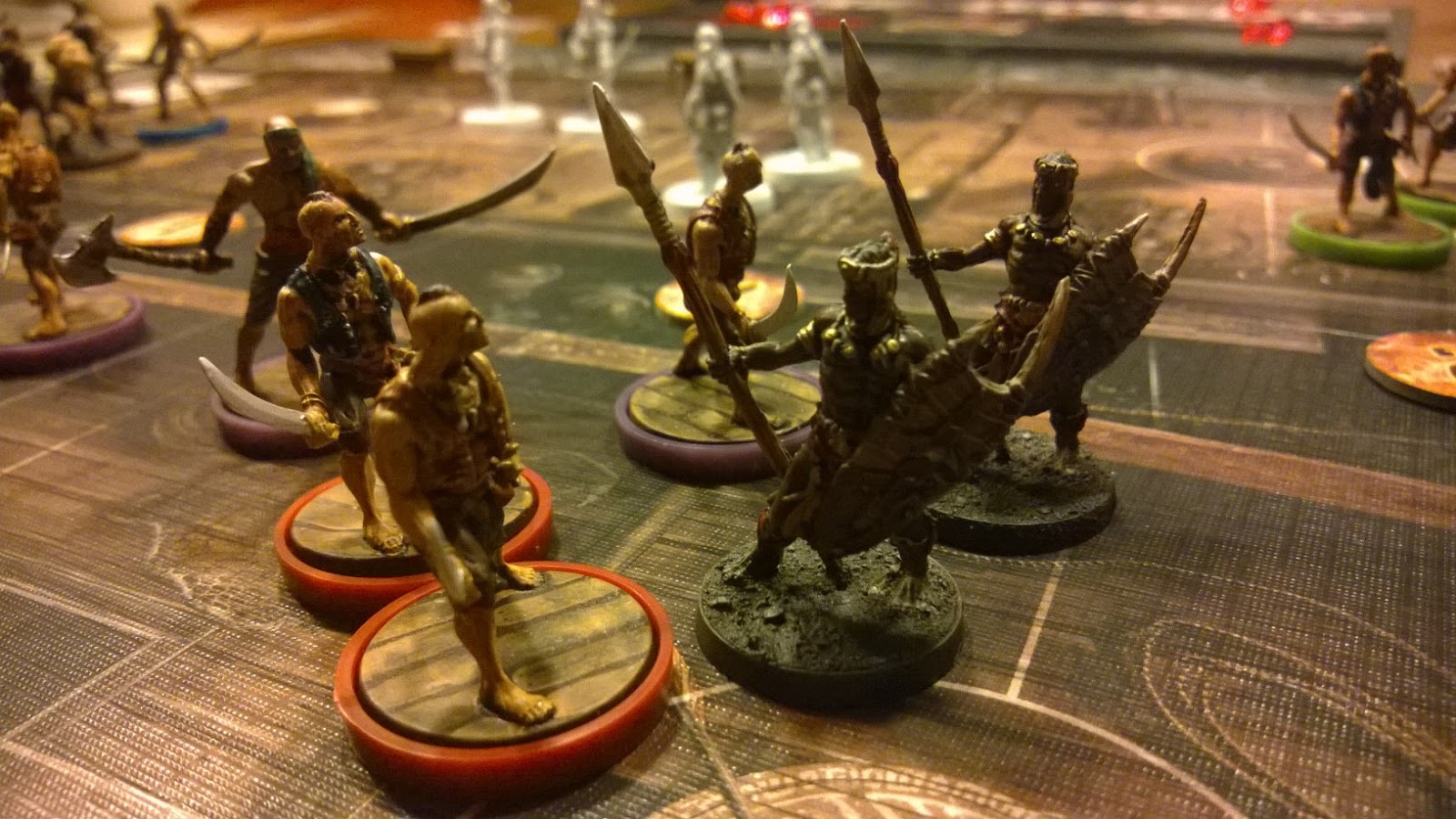
The first thing that grabs the attention is the excellent visual appeal this game offers. I am not ashamed to admit that I entered the Kickstarter campaign solely for the miniatures, before I even knew what kind of game it was. The board and card materials all are first rate prints based on exquisite artwork by several very skilled artists.


The game is a semi-cooperative boardgame. Hero players play against one opponent: the player that plays the Evil Overlord. Hero players play one or more heroes, the EOL plays all opponents. The game has several very clever innovations that will be described below.

The basic game offers four playing boards, printed back-to-back on heavy cardboard. These allow you to play scenarios on two pirate ships, a Pict village, a tavern (of course!) and a ruined fortress. The boards are dived in board areas that allow movement across the board. Movement is hampered by terrain features printed on the board (good lighting is recommended during a game!) . Line of sight is simplified by white dots printed in a board area. If you can draw a line between two white dots without crossing a terrain feature, you have line of sight.


The piece de resistance of the game really are the miniatures. They are SUPERB. Made of tough plastic they (with one or two exceptions) are beautiful sculpts with great detail. They paint up beautifully, but some will take some skill to get right, as the detail on especially the female figures is very small and finely sculpted. The figures would be an asset to any wargaming collection, even if you never play the game itself.


I was pleasantly surprised that Conan was not just a pretty game, but a good game as well! So how does it play?

The Hero players use Character cards that hold all information, weapons and skills of the Heroes. Skills and equipment enable you to do special things or roll extra dice. Nothing special here.

However, each Hero has an amount of Energy (blue plastic gems) that enable the hero to take actions. A Hero may take any action he wants in any sequence and as often as he wants. However, each action costs Energy and when Energy is exhausted, no more actions are possible. Reclaiming Energy takes time and you will get the point, dear reader: spending Energy is a lot faster then reclaiming it! This makes for interesting dilemmas. While a Hero can take a breather instead of a turn full of action, this will still not give him back all his Energy, so energy management is a crucial element of this game.


The EOL has about the same amount of Energy at his disposal as a Hero, but reclaims it faster. No luxury, since his Energy must power ALL adversaries. He does this using a clever gaming ad called The Book Of Skelos. The main feature is "The River" where he keeps his character cards. The more to the left a card is placed, the cheaper it is to activate. Once activated. the card moves to the right and can only be activated against a bigger Energy cost. The entire "River"then flows to the left. So the EOL can activate every card he wants (twice per turn) but the Energy costs may vary enormously. Here, too, energy management is the key.


The skill and combat system has cleverly and completely done away with modifiers by using special coloured dice. The yellow ones are the least effective, the red ones the most. No math is required, just pick the right number of dice of the right colour and roll them!

All this makes for a game full of well-pondered decisions while still flowing fast enough to get that action-packed feel that is essential for the world of Conan.

The game provides several scenarios to play, which may also serve as inspiration for writing your own.

There are some point of criticism of course. Some miniatures are not very good. Different sculptors worked on the game and a few of the earlier sculpts (Conan's lion being a sad example) are definitely of lesser quality. But they really are the exceptions, as the pictures will testify.

The orginal rulebook (separated in a player's book and an EOL book) provided in the Kickstarter simply sucked.

Parts of the rules were missing or badly translated from French. Inventory lists are missing  and determining what you would need for a scenario is a puzzle solved only by reading the scenario and looking at the graphics VERY closely. However, Monolith is correcting this as I write to provide a better rulebook that will be downloadable free of charge.

There is a plethora of marvellous expansions dealing with Khitai, Stygia and the North, making the longevity of this game even better.

Containing all this treasures, Conan does not come cheap. It is definitely a high-end miniature boardgame and has hit retail at prices around 120 dollars/euros. Still, I recommend it heartily! You will paint and play for ages with this game.


Tin Soldiers in Action - A review-

People who know me will know that I am a compulsory collector of war gaming rulesets. I own dozens and I never tire of reading new ones. Be it skirmish or big battalion, card driven or IGO-UGO, 70ies style stencils or full colour hardback tome, they can all be divided into three categories; “Oh it’s one of those”, “Let’s play this” and the most interesting of the three: “Hey that’s funny….”


Tin Soldiers in Action, written by the brothers Rüdiger and Klaus Höfrichter, definitely falls fairly and squarely (heheh, just wait…) in the last category. 

TSiA is an attractive quarto sized hardcover book of a sizeable 270 pages in black and white and a full colour centre section. 270 pages!?  Yes. And no, it is not a complex and intricately detailed simulation, it’s actually a rather fast-playing game written with exactly this in mind. It is meant for the late 17th century up to the start of the Great War.

The game radiates old school classicism. The book opens with a thorough index and explains the motives of the writers and the principles of the game in clear (and to my 50+ eyes) pleasantly large font. As a matter of fact, the book’s athmosphere takes you back to the days of Charles S. Grant when rulesets were books which calmly explained how a game worked to people that had time to read this in rest and earnest. So the book meanders from some gaming philosophy via scales and dimensions to unit organization, weaponry, formations and special troops to game mechanics. Thus pass the first 90 pages or so with few tables, some illustrations and clear text.  

The combat mechanics are well-tried, based on D6s per figure (or gun) and work with range and terrain modifiers that simply divide or multiply the number of D6s rolled. It is in Movement and terrain that the game produces its novelty. TSiA does not use classical ranges and distances, but instead works with a square based grid.

This initially put me off a bit. The advantages were of course obvious: no need for measuring, no discussions about movement ranges or relative distances, no discussions about firing ranges. But what would separate TSiA from a board game? And I really like my terrain; how good could a table look with a grid?

As it turns out that could be just as good as a normal table. As long as you are willing to use coordinates on the side of the table and support the grid with terrain. For example, a wall or a river may form the border between two grids. As the colour pictures in the centre of the book testify, this will result in very attractive table tops!

This extreme simplification of terrain would have had consequences for some of the classic dilemmas of war gaming: moving across or into difficult terrain. When a unit simply moves one square, how about speed and slowing down? This is cleverly countered by causing troops that enter difficult terrain to become disordered instead of slow. Disordered has some undesirable consequences so even on a grid, difficult terrain is not something to take lightly.

Morale also enters into the game under the label of “Tenacity” and is a factor of a unit’s size. 

For the game sequence the designers chose another game favourite of mine: the game is card-driven. Normal playing cards are used. A number of card turns make up a game turn. Each unit has a card upon which it may take action. This may be one or more actions depending on the vicinity of their commander. These actions happen during the phases of a card turn. Actions are ordered (announced) and Tenacity is tested. At the end of a turn close combat takes place and then a next card is drawn, restarting the turn until all cards have been drawn and the next game turn begins.  

All this –having seen it played a few times- makes for a quick and entertaining game that does not seem to suffer at all under the lack of flexibility in movement speeds and firing ranges

Furthermore the book offers tips and rules for terrain, special troop types for all kinds of areas, army lists for the Age of Reason, the Napoleonic and the Victorian Age, alternative forms of organisation (i.o.w. a point system) and several scenarios with extensive description and variations.

Finally the book offers a FAQ and a Quick Reference Sheet which is, despite the book’s hefty page count, a mere 2 pages long.

As stated, I have seen the game played a few times but have not yet gotten the chance to play it myself. Still, games were obviously fast and enjoyable while still employing a rather large number of miniatures. The grid based movement sets the game apart from the mainstream war games and is, in that respect, more abstract. Still. it doesn’t seem to detract from the experience that the players are playing a miniature battle.

Conclusion: innovative, definitely something different and resulting in an enjoyable game: recommended!

Tin soldiers in action
Rüdiger and Klaus Höfrichter
Partizan Press 2016
Hardcover, 270 pages
Price around 30 euros


Saturday, November 19, 2016

Conan by Monolith: a Sneaker Peek

While November has been an insanely busy month so far, still I have managed to paint some stuff from the magnificent Conan Kickstarter and play two games as well. While not yet ahead in the review queu, at least I can treat you all on some pictures!


Monday, October 17, 2016

Review and Pics of The Chicago Way

Based on the very successful Dead Man’s Hand ruleset Great Escape Games transferred their Wild West rules to another wild period in US history: Chicago in the Prohibition Era.


For those who do not know this period: in the 1920ies the US made an enormous effort to ban the drinking of alcohol altogether through drastic legislation and government  control. It became the most spectacular failure in the history of anti-drug legislation until the start of the War On Drugs in the late 20th century. It cost the US government a fortune in missed taxes and costs of crime-fighting. But most of all the wave of liquor-related crime following the Prohibition laid the foundation for organized crime in the US for the century to come. When the US government finally repealed the Prohibition in the early 30ies numerous powerful gangs had become rich on the liquor trade and were ready to transfer their business to other, more durable crimes like the drug trade, gambling and prostitution. 


However, The Chicago Way takes place before this, replaying the dawn of organized crime in Chicago in the 1920ies where the likes of Al Capone and Bugsey Malone carved out their criminal empires with bribe money and tommyguns.

TCW is –of course – a skirmish game. Players will need between 6 to 8 figures to represent an average gang or police unit. Teams may represent urban gangsters, moonshiners, policemen or federal agents. Besides these a handful of civilians may be used when the game calls for it and of course a lot of 1920ies terrain like urban buildings, lantern poles, fire hydrants and the glorious cars of the era is needed.


TCW is card-driven and comes with its own set of cards; a colour for each of the factions. Bad guys are black, good guys are red. Cards have multiple functions. At the start of each turn each figure on the table is awarded a card. The rank of the card determines Initiative in Activation and each figure gets three Actions at that point. Actions are treated quite realistically. You can shoot a lot if you remain stationary, but shooting gets more difficult or even impossible if you do it more or if you combine it with walking or running.
On top of all this, when being attacked or shot at, a figure card may also be used as a Reaction to shoot or Move.


Besides this you also hold a “hand” of cards. Held in hand, they can provide ad hoc advantages or actions throughout the game, often out of turn, like stealing your opponent’s card, avoiding mortal wounds and the like.


TCW uses D20s to determine hits and D10s for Nerve and Skill Tests, like Driving a car. The car rules are suitably spectacular in that a 2+ Drive test is required for every action, which gets more difficult as the car is hit more often. Cars are no so much destroyed by gunfire as being made uncontrollable and will eventually crash if you continue driving a damaged car long enough. This brings us to the hit system. Figures are hampered by hits as long as they stay alive and will “die” when a certain number of hits is reached or instantly when being hit with a 19-20 result. They may however ward off death by spending Actions to lose hits.

The rulebook is a pleasant full-colour A4-format 42 page paperback containing complete rules, scenarios, counter- and driving templates, team rosters and a campaign system (as yet untried by me) which comes with a pleasant surprise as it contains an underdog rule. Which is essential to any campaign, as structural unbalance between players will ruin any campaign pretty quickly!


TCW results in fast, cinematographic games (between 1 and 2 hours) that emulate the many gangster movies, comics and novels. 

Recommended!