For years during the first decade of this century my go-to ruleset for wargaming was Warhammer Ancient Battles, basically Warhammer Fantasy Battles without the Fantasy. It was the best ruleset around in my not-at-all humble opinion in the sense that it was the best playable ruleset that I could find after reconnoitering horrors like DBM. It was however a clunky, typically 1990ies ruleset with lots of tinkered bits screwed on and a lot of frustrating stuff. I eyed the fantasy version of WAB but that already seemed terminally broken and cheesy.
When WAB went, I looked around for replacement. War & Conquest was promising and better, but still retained some of the frustrations and failed to attract opponents. Hail Caesar showed me that the Black Powder engine was fit more a lot of things, but not pre-firearms wargaming. It was bland and tasteless. Kings of War had nothing that intrigued me. So little showed up and over the years I sold most of my armies.
And then Oathmark was published. I succumbed to the hype, bought the rules, painted an army of dwarves that had been gathering dust for years, dug out some more fantasy stuff I had laying around and played some games. And was hooked. Why? Well, to be perfectly honest because it plays like Warhammer with the same joy and without the frustration.
The rule mechanics
The credit for this goes to the rules of course. Joseph McCullough, he of Frostgrave fame, used his thoughts on wargaming to write a mass fantasy battle system and in my opinion he has succeeded very well. And by doing this he crushed quite a lot of conventions that have ruled mass fantasy battle systems for years.
First, this is not an IGO-UGO system but has alternate activation. Players alternately activate units. So it doesn't have turn phases either. An activated unit has two actions and may move, move a lot, shoot or charge into contact and if it does so a bilateral combat occurs immediately. Activation rolls are no do-or-don't affairs. A failed Activation roll limits your actions, but still enables you to do things with that unit. These two things make it a dynamic game that constantly engages all players.
Second, Oathmark ditches Priestley's Law (Only D6 Games Will Sell) and uses D10s. Predictably this will give more gradual and less predictable results.
The rest of the mechanic seems relatively conventional. Units have stats like Move and Fight, need to roll a minimum value to succeed in things like Activation rolls and Hits and roll for Morale when taking casualties. There are the traditional races like Dwarves, Humans, Elves and Orcs and Goblins.
However, all rolls are achieved with a maximum of 5 dice, never more. Also, a Die roll always causes an immediate result. So no To Hit/To Wound/To Save sequences. Just a Defence minus Fight = Target Number roll and a success is a hit. No buckets of dice here.
The Army building
Army building is done brilliantly. There are two ways. First you can traditionally choose a race and take units from the list of units of that race (and some unaligned ones). Units have a point value so you can tailor battles to a specific point value to balance things.
WARNING: building armies this way leaves the game open to all kinds of min-maxing tricks that will eventually completely derail the game balance!
Alternatively (and MUCH recommended!), you can build a Kingdom with a capital of a specific race, but additional territories that enable you to field units from different races as well! While other races' territories are slightly more expensive to "buy" into your Kingdom, you can take any. But not all. You can only take 10 territories out of 44 as your starting Kingdom and each territory gives you specific units of a specific race. For example Plains give you Human cavalry. I created the Kingdom of Dale/Erebor from The Hobbit this way.
The differences in races are notable. Elves tend to be expensive and extremely disciplined elite specialists, are very hard to break, will almost always activate but are never numerous. On the other end of the spectrum there are the goblins, brittle, undisciplined and mediocre at best but cheap enough to field them in hordes.
This means that in order to create an army that excels in everything, you need to enlist different races. For anyone that learned Fantasy in a GW store, this is heretical! But if you were raised with Tolkien, all this should come easy to you. 😁
There are multiple troop types (although not all races have all troop types) like several infantry types (spearmen, linebreakers, militia etc), cavalry (heavy and light, horse and wolf) artillery and a list of aligned and unaligned monsters and creatures that either fight in small units or alone.
A unit is kind of standardized. Man-sized figures are deployed 5 rows wide and 1 to 4 ranks deep. A unit is never bigger than 20 figures. Bigger figures like trolls deploy in one rank of 3 or even alone, like Dragons. Ranks give you bonuses in To Hit roll, Morale checks and Shoot rolls, but make you more vulnerable for artillery. A good dilemma improves a game, I always say!
There are Characters, but they are not the one-man juggernauts from Warhammer. Instead, a General actually Commands units (he can activate more than just his own unit and boost Morale Checks) and Champions might at most give an extra Kill in combat or may challenge enemy officers or Champions. They actually feel and play like the troop type they are supposed to represent.
Spellcasters are powerful, but expensive characters. You can buy them in levels and the higher the level, the more spells and the more dice you may roll to cast them. But also much more expensive. Spells can only be cast once per Activation per Spellcaster, can make a powerful impression but so far have not been gamechangers.
Monsters can be very impressive, like the 800 point Winged Dragon which is practically a small army in itself. However, in a 3000 point average game it will eat up over a quarter of your points, so it better be a gamechanger. That amount of points will buy four (4!) full units of Goblin soldiers!
So how does it play?
It plays fast. Units are not particularly fast, but they are maneuverable. This is because units may move or maneuver through obstacles as long as they can end their movement in formation and outside the obstacle. So you are spared the horrors of "clipping" and being unable to move because your unit was 2mm too wide. Besides, even failed Activation rolls enable one Move action. So there is always something happening. The game never drags. You never have to wait for something.
Combats are fast because both combatants roll simultaneously for their own Target Number and remove casualties and then one or both units move away from each other. Combat can be very bloody between unequal opponents and units with large losses will have trouble to make their Morale check. And when already Disordered (after one failure) a failed Morale check will send a unit packing.

As a player you are always engaged, since combat follows contact immediately, both players need to roll and after your opponents activates a unit you immediately are next. The game continues to flow until one of the armies breaks or retreats.
The rulebook
The rulebook is extremely well laid out. It is teeming with clarifying diagrams and subjects are usually explained in one or two page spreads (with accompanying tables) so you almost always find what you are looking for on one page spread. There are the main rules, advanced rules, scenarios and Kingdom and Army building chapters. There is a Campaign chapter that explains how your Kingdom may expand (or shrink!) during a campaign, which might give you access to new troop types. There are army lists for Dwarves, Humans, Elves, Goblins and Orcs as well as aligned and unaligned Monsters and other creatures.
A few rather important rules are a bit hidden away in some surprising locations in the rules, so read them really well (which is always a good thing by the way). It took me a while to spot the fact that a failed Activation roll wil raise your target number for shooting by +1 (which is mentioned in the bit about Simple Actions rather than Shooting) and I needed someone to point out to me that a so far unactivated unit that has been engaged in combat i.e. has been attacked cannot Activate anymore in that turn (which is mentioned in Activation rather than Combat).
It is a visually pleasing book too. 192 full colour pages with lots of pictures, paintings and drawings bound in hard cover.

The miniatures?
While there is a line of Oathmark miniatures from North Star anythings goes really.
This might however be the place to say something about basing. Oathmark bases human-sized figures on 25x25mm and bigger figures on 25x50, 50x50 or 50x100. So a unit front is either 50, 125 or 150mm wide. This already tells you that front width is not extremely important, just handy.
Don't rebase your 20x20 or 25/round stuff. The important thing is to remember that a unit frontage is 5, 3 or 1 figure wide (depending on the size of the figure). In combat the attacking officer always lines up in the middle of the frontage he is attacking with his unit. Maneuvering units may move through obstacles as long as they don't end on top of them. So the exact width of a unit is not very important. At most, a unit of 5 20mm bases wide can deploy in a 100mm corridor instead of a 125mm one. I have yet to see that happen.
So don't rebase or get hung up on base sizes. No need.
What could be better?
The book made it out of the printing process with some printing mistakes. The Oathmark players' Facebook page has an errata list. An official one is in the works. Nothing to get upset about.
Overall Oathmark seems to have been quite well tested. So far players have only found one Spell that seems to invite abuse (Smoke) as well as one rule (Making Room on page 34, see below for a possible solution). The rest of the game seems to work very well and as intended although those intentions are not always to anyone's taste, but well, wargamers will be wargamers.
The Conclusion
An extremely enjoyable mass fantasy wargame. It will capture my attention for quite a while to come. Extremely recommended!!!
The Sequel?Three additional books are published at this time and reviewed
here.
EDIT October 29th 2020: Dragons
The consensus seems to be emerging that Dragons are Oathmark's equivalent of the nuclear ICBM i.a.w. unbeatable by anything except another Dragon. We played one game so far with Dragons on both sides. The Dragons mainly fought each other, but when they didn't, they were indeed lethal against other units. However, although killing them with something other than another Dragon is hard, pinning them in place is relatively easy, thus neutralizing quite a large amount of points while you can defeat the rest of the enemy's army.
EDIT March 16th 2021: Artillery
Some words about artillery. Having played a number of games I have noticed, as have others, the effectiveness of artillery. And not only catapults and such but long-range magic as well. When playing a slow moving army on an open plain (a really classic setup after all) against an Artillery- and Magic rich army your army will be severely held up and weakened along the way, only to be massacred when finally in contact. Artillery is very effective, especially in combination with artillery-enhancing or -replacing spells.
This not a fault IMO. Rather it forces you to play accordingly and choose your tactics and battlefield better. You will need screening units and cover against long-range fire. Gaming tables will need -and feature- surprising amounts of terrain after a while.
Playing Oathmark is in that respect actually more like late 19th century warfare than Ancient or Medieval.
In a world of magically enhanced artillery, no general worth his salt would consider advancing slowly over an open plain. The results would be predictably disastrous. And in Oathmark, they are. So take note. This is Fantasy wargaming after all!
EDIT July 29th 2021: Some suggestions for Houserules
After a few dozen games and a new Errata and FAQ edition I thought it time to give my views on Oathmark Houserules. Oathmark is a good ruleset, but not without problems. Fortunately the designer encourages tinkering so no problem needs to stay unsolved!
First, the most recent FAQ at this moment is to be found
here. I think this has some problems as well, to be addressed below.
Dispelling
This spell may be cast on any unit and lifts the effects of an earlier spell cast on that unit.
Unfortunately, some Spells are not cast on units and are therefore invulnerable to any countermeasure. Some rather significant examples are Smoke and Looking Glass, which will usually bother you the entire game. Especially Smoke invites abuse this way (for example, a unit standing right behind the Smoke can never be Charged from the front, as the attacker has no LOS through the Smoke and may not approach because the distance would be less than the minimum of 1"), so we thought this needed the following Houserule:
All Spells can be Dispelled, unless the Spell description explicitly tells you it can't (like Mud).
Making room for an attack
On page 34 you will find the next paragraph of text:
In rare cases it may be necessary to move a unit that is not involved in the combat slightly to make room. In this case move the unit directly backwards until it is at least 1"away from the currently active unit.
To be honest we never used this. But its potential for abuse and bizarre game effects is immense.
Apart from the fact that it doesn't describe what "rare" is supposed to mean and conversely you can actually use the rule all the time, this makes it extremely hard to shield any of your units from attacks as long as the attacker has LOS to his intended target. It also makes it extremely hard to block an attack by placing your units in your opponent's way of Move or Maneuver, as long as he has LOS to his intended target.
After all, the attacker can simply oblige you to move your shielding unit backwards until it is out of the way so that he can attack the unit behind it and can now maneuver unhindered because your unit hindering him simply moves backwards. As long as your unit can move backwards, it apparently is obliged to do so.
This completely removes any motivation to maintain battle lines (which are of course meant to prevent just such a thing) and the idea that a unit would simply move out of the way to make room for an attack on its neighbor is too weird even for fantasy. To make problems even bigger this rule made it possible to hugely abuse the flanking rule and gave cause to another weird FAQ adaptation (see below).
From the moment that I discovered this paragraph I have been completely baffled by its possible purpose so I contacted the author for clarification. As it turns out the rule was meant for the situation that:
a) the attacker moves to charge and makes contact with its intended target
b) the attacker's unit must now be placed flush against the target unit
c) but can't since another enemy unit blocks this.
d) so this enemy unit is moved backwards etc.
To be honest, knowing this, I still think the rule is unnecessary. When an attacker does not fit against the target unit I'd say that the charge should be considered blocked. The target unit is then simply too well shielded.
So my suggestion would be to completely disregard the paragraph on Making Room on page 34.
If you do insist on using this rule, I think it should actually have been written down like this:
In case an attacking unit has already made contact with its target but cannot be placed flush against the target due to another enemy unit not involved in the combat it may be necessary to move that last unit slightly to make room. In this case move the unit directly backwards until it is at least 1"away from the currently active unit.
It still leaves to be desired though. What if the unit that makes room bumps into an obstacle or another friendly unit? Does this make the charge impossible or is this a pushback? It just causes more questions. Better to disregard it completely.
Flanking and rear attacks
The rulebook on pages 34 and 35 gives pretty clear rules on when a unit attacks a flank or a rear. The front, flank and rear quadrants are found by drawing diagonals through the unit's "footprint". When you attack a unit, which must always be done by a Move straight forward, the moment of contact and the location of your unit's officer determine in which quadrant you attack.
Unfortunately, the "making room" rule opened this up to immense abuse. Imagine your unit is facing an enemy unit A right in front of it at a few inches distance. To your right front is another enemy unit B. Now you announce that you want to wheel to the right and attack unit B. This is impossible, since the unit A in front of you is in the way, so you move that backwards until completely out of the way with the help of the Make Room Rule. You are now positioned in the flank of unit B and proceed to flank attack that unit.
To solve this, the designer did not simply trash the Make Room Rule (like he should have done IMO).
Instead he completely rewrote the rules for Flanking and Rear attacks. Now the start of the Charge (whatever that may mean) and the location of the officer determine the quadrant in which the attack takes place. Firstly, this makes it necessary to painstakingly measure in which quadrant the charge starts.
Also you can now have a unit with a narrow front starting its charge inside the flank quadrant of the target unit and, due to its movement direction at the start of the charge, ending up entirely in the front quadrant at the moment of contact, only to be then dragged around the target unit until ending up on the flank.
Finally, the attacker from the example above can still force unit A backwards, wheel to the right and attack unit B. Only now the attacker is making a "frontal" attack, as this is where his officer usually starts (I think, since it is unclear whether the Charge "starts" with the Wheel or with the Move Forward) and is dragged to the front of unit B. Thus having essentially now made a charge by moving more than a full move to the right, which is normally not allowed. It boggles the mind....
Suffice to say that in my not at all humble opinion this creates even more complications, unclarities and weird situations. So ironically my suggested Houserule is to play the Flanking and Rear attack rules simply from the book and:
To completely disregard the first two Q&A's from the "Other" paragraph from the FAQ as well as disregard the paragraph on Making Room on page 34 of the rulebook.
Oathmark: Battles of the Lost Age
Joseph McCullough
hardcover
Osprey Publishing


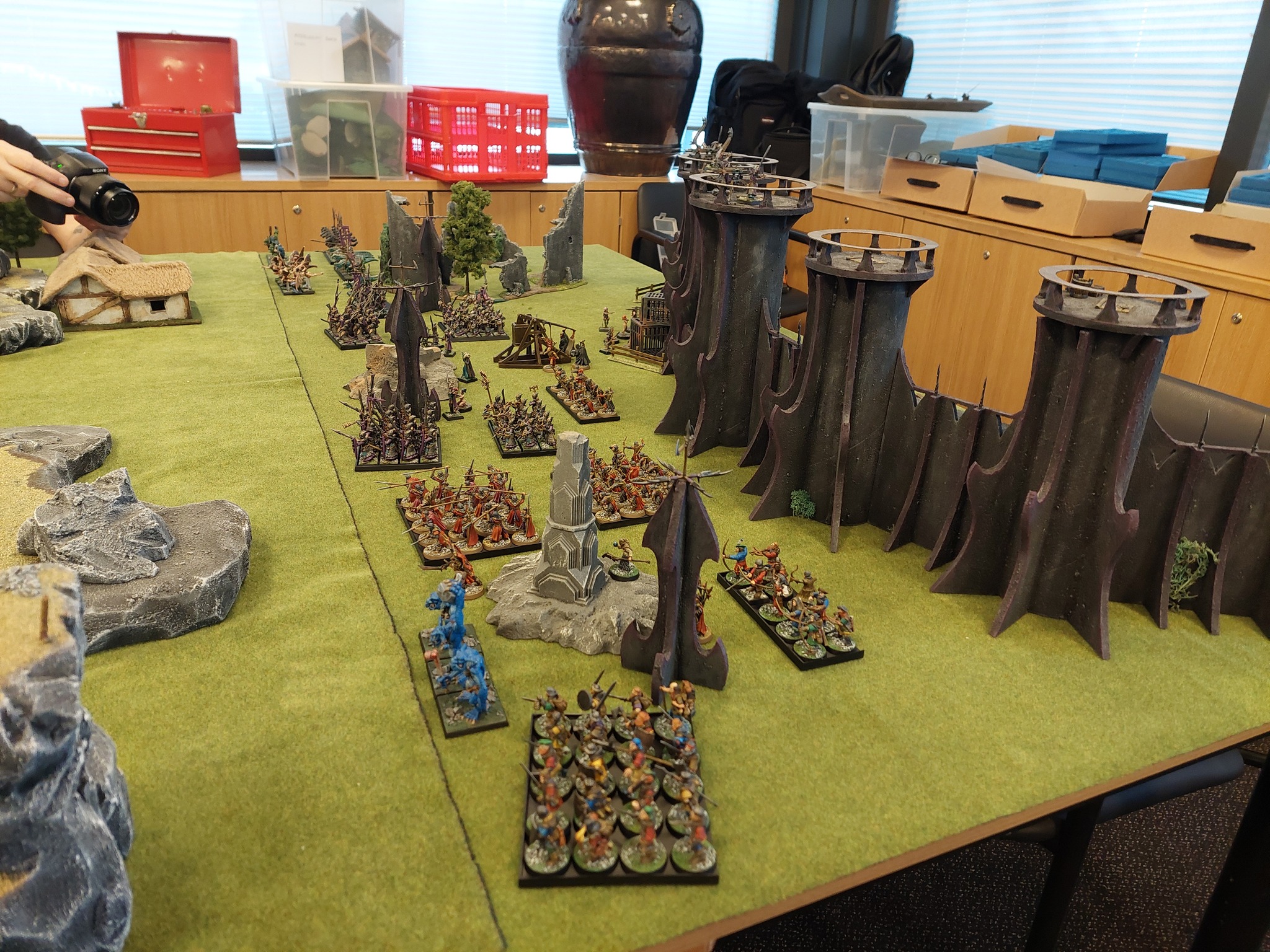


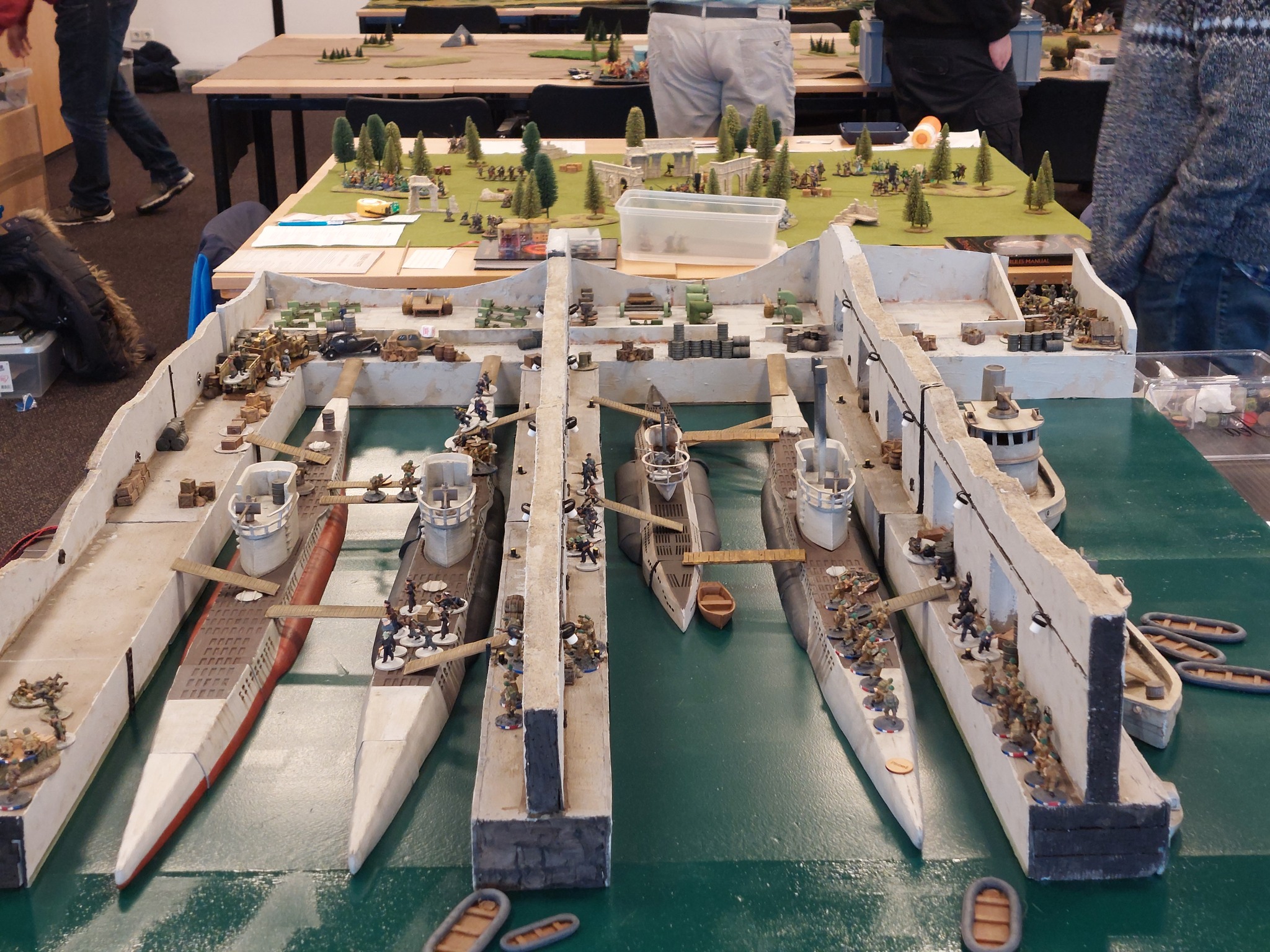


 Many thanks to Patrick for his great table and even greater hospitality!
