After a long spell of real-life busy-ness I managed to complete my painting the Witcher: The Old World board game miniatures.
So here they are. More blogs will be here shortly!


After a long spell of real-life busy-ness I managed to complete my painting the Witcher: The Old World board game miniatures.
So here they are. More blogs will be here shortly!

Probably inspired by that conversation (and before I knew it) I spoke the ominous words: I won’t buy miniatures for a year!
Dear reader: I know what you are thinking now. Why would he say such a thing? Did he succeed? What did he learn from it? Would he do it again?
Safety
nets and pitfalls
I must say
that I had a LONG painting queue lying around at the time, so I didn't mind
finishing that first and spending more time playing games. This notwithstanding,
I nearly walked out of a model shop with a box of figures within half an hour …
But I
caught myself in time and got through the first few hours with my honour unscathed!
I really
did not buy any figures during that year. However, honesty compels me to say
that some miniatures nevertheless did find their way to me. A Kickstarter – ordered
before that time – arrived in 2022. I also got some miniatures gifted now and
then and one or two swaps also resulted in new figures. In any case, the
total collection did not shrink in that year.
Triple
focus?
I painted a
lot of figures. Almost my entire stock of 28mm Modern and Vietnam, a whole bunch
of ancient Necromunda figures and a handful of collateral projects successfully
ran into a brush during the year. As well as the Kickstarter which, of course, was
also painted.
Buying rulesets was of course allowed and that gave me a few new projects that I could do from my existing stock.
I also built a lot of terrain, because well, both old and
new projects revealed some things lacking in my terrain collection. So now I own
a village and three landing boats for Vietnam, a colonial plantation manor for various
periods and a medieval Pele Tower I felt I realy REALLY needed.
However, as
a consequence of this frantic terrain building the 19th century Japanese and
the WW1 collection are still looking at me, dressed in primer color, somewhat
reproachfully. Not buying worked out fine, but focus? Not so much….
The art
of inventory management
Along the
way I noticed that my inner hobbyist became a bit more relaxed because I could
ignore all the blingbling passing by in my newsfeeds. After all, I wasn’t going
to buy anything anyway. This way, I was not putting pressure on myself with new
purchases and ambition to do something with them “soon”.
Instead I
realized some long-cherished plans (which I will have to play with at some
point, of course). I also had a lot more time to try out new ideas and have
become a lot more proficient with airbrush and styrofoam than I used to be.
Although the successful completion of a few field projects left me with an
acute storage problem….
I also
noticed that it's okay to get a new idea and think about it without buying
everything right away. You can always do that after that year 😊 The special thing was that I actually didn't
feel limited because I didn't buy figures anymore, but felt more freedom to do
more with the stuff and plans I already had laying around.
Rinse
& repeat?
I don't
know if I would do it again. I also don't know if I have to.
I have now
ordered some stuff that I have made plans for, but I notice that I let other things
pass by more easily. It didn't save me any money though. Instead of buying
figures, I just started investing in game rules and tools.
I hook up
with other people more easily to play games, which is great fun. I also really
enjoyed browsing through my existing collection and doing things with it and I
actually still do. Of course you need a collection and some stock to do that.
But let’s be honest; if those aren’t there, you don't need a buy stop anyway right?
So all
things considered, it brought me some good things. And no, there were no withdrawal symptoms! 😁
 |
| The Caller |

 |
| Ratskin sniper and The Caller de-ratted |
 |
| Delaque Gang Leader |
 |
| Rippers |
 |
| Ratskin warrior and Shaman |
 |
| Kal Jerico and Scabs |
 |
| Spyrer Matriarch and Patriarch |
 |
| Pit Slaves |
 |
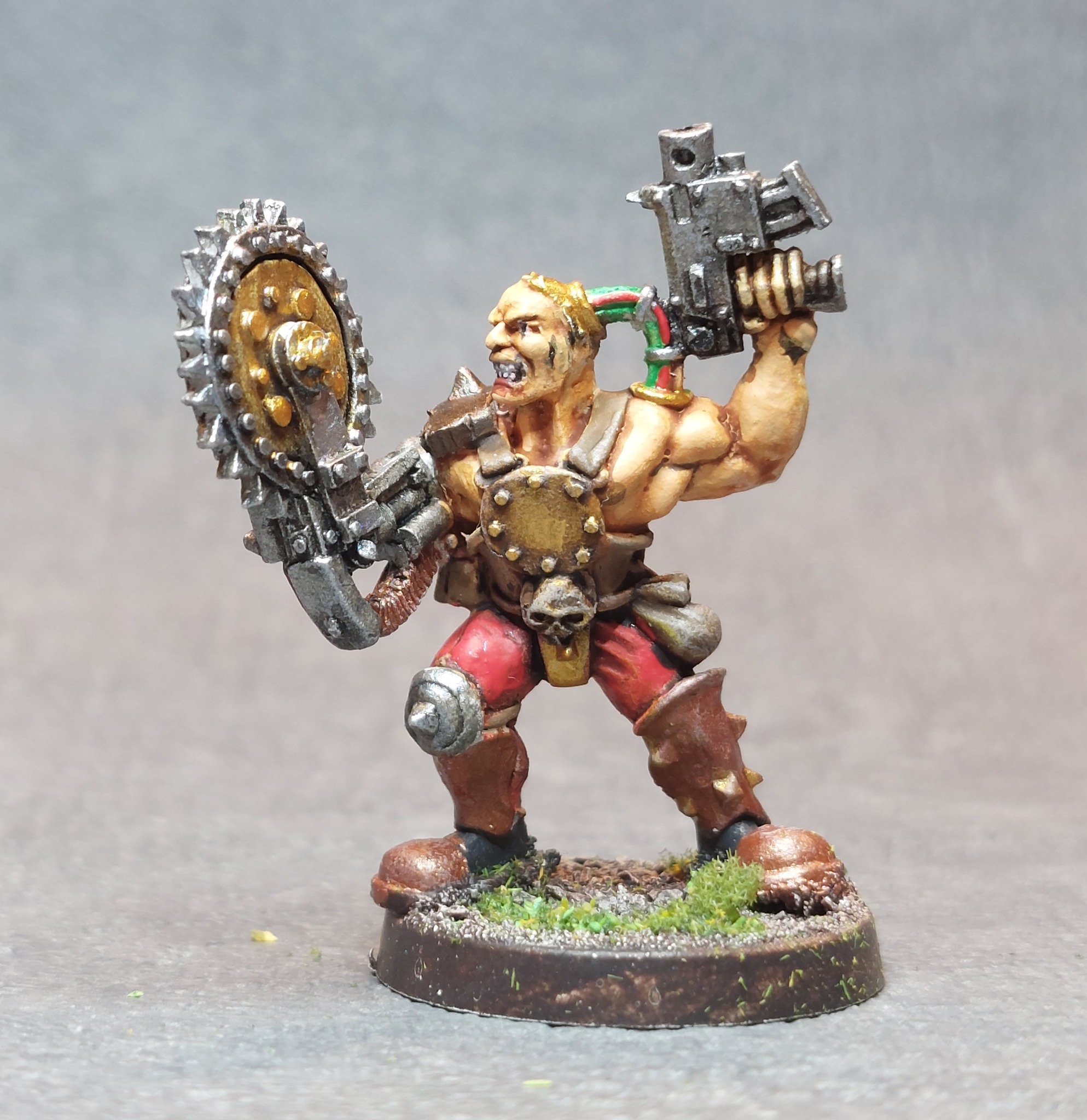
| Dleaque Heavy and Juve |
 |
| Pit slave |
 |
| Pit Slave |
 |
| Wyrd |
 |
| Spyrer Jakara |
 |
| Spyrer Yeld |
 |
| Goliath gang leader conversion |
 |
| Goliath Ganger conversion |
 |
| Beasts |
 |
| Goliath gang |
 |
| Orlock gang |
 |
| Spyrer Gang |
After months of being too busy to do any blogging the holidays arrived and I had some more free time on my hands. And one of the things I did with that was converting a GW Ogre to Bull Gorg, the Necromunda Underhive Spartacus of the Pit Slaves.
 |
| The one and only picture of Bull Gorg. GW never made a model of him to the best of my knowledge. |
 |
| The basis: a GW Ogre and some Mecha parts. |
 |
| Starting to fill all holes, building the two turbo chain swords up with plasticard and greenstuff |
 |
| Some details and experimental headcover. Clearly an unfortunate choice. |
 |
| More gut.... |
 |
| Even more gut, a beard trim and experimental cybernetic thingies on his belly. Mwah. |
 |
| Soldering wire to cable his chainswords. And a powerpack and base debris. |
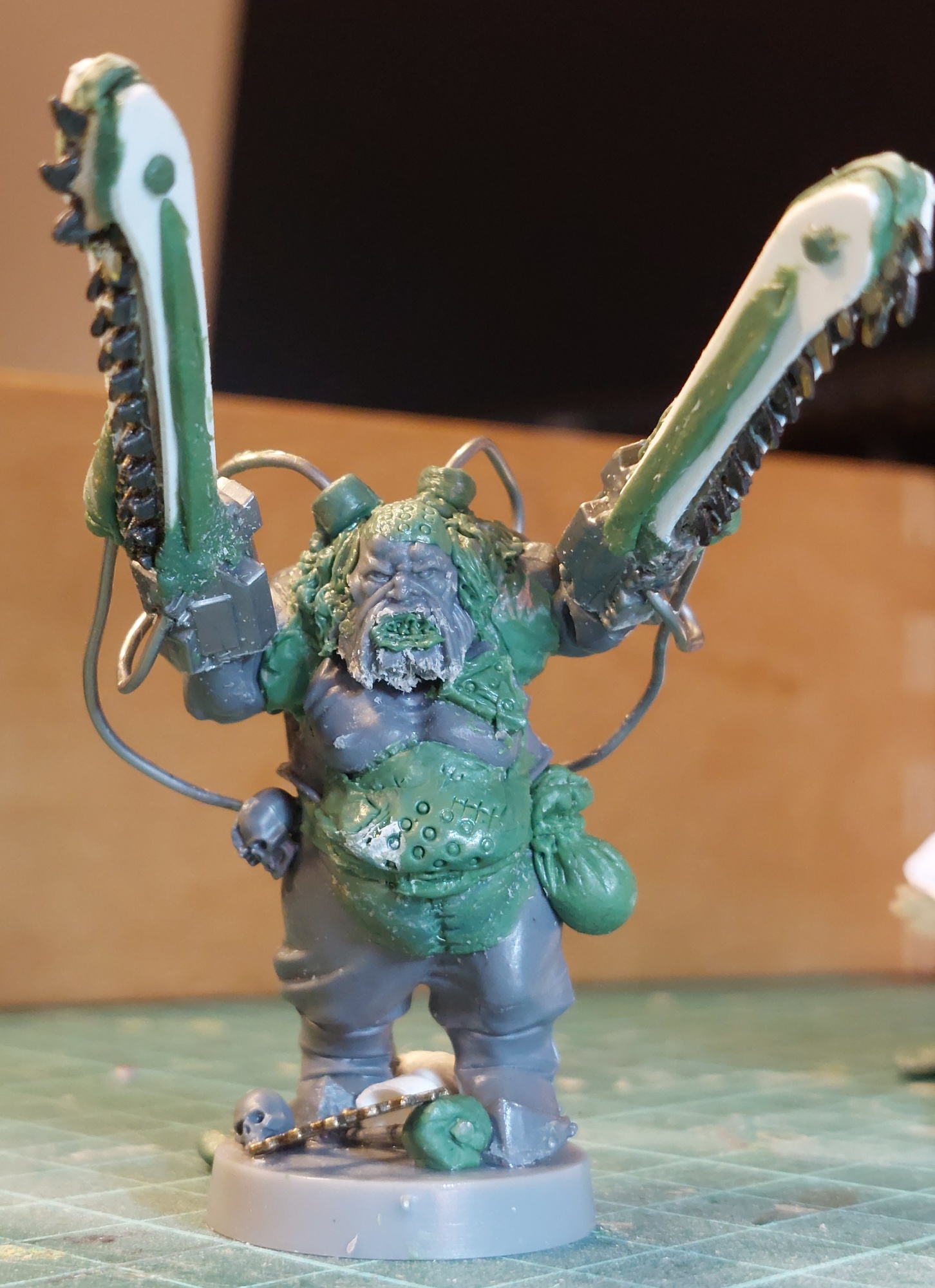 |
| More details, better cybernetic belly thingies and an open growl instead of his closed mouth. |
 |
| And the paintjob. |
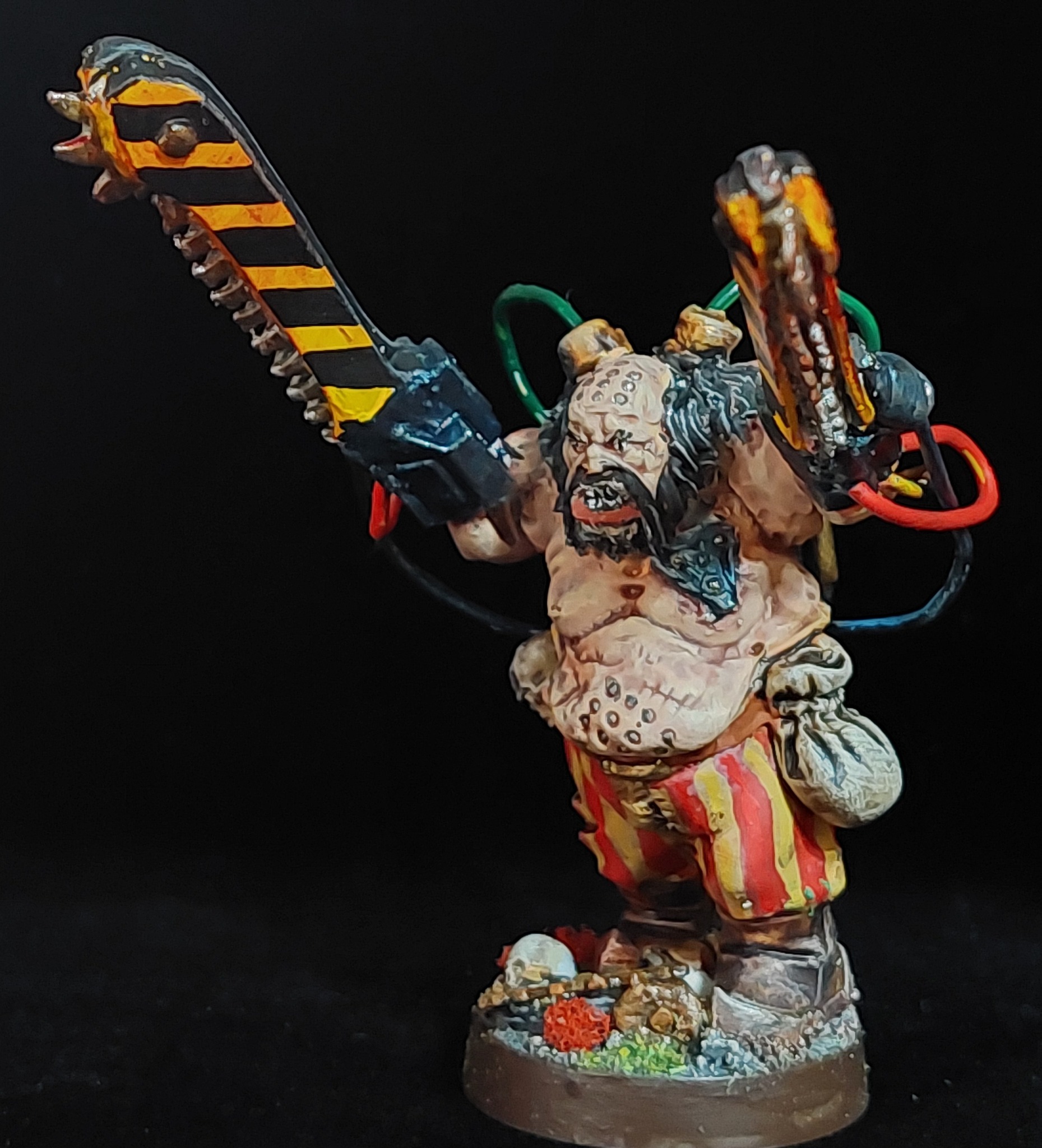 |
| I like him. He looks a tad unstable, but once you get to know him better...., well, you are certain he is completely bonkers. |

The Barons' War is a 28mm medieval skirmish ruleset for a tabletop wargame by Andy Hobday and is published by Footsore Games. With a few games under my belt I felt ready for a review.
 |
| Rulebook and counters |
The game was either followed up by several medieval figures Kickstarters
by Footsore Miniatures or caused by them. I missed the exact order of events
but in any case this means that the game is accompanied by the Footsore range
of very good miniatures for 13th century England. But these miniatures are not
my objective; the ruleset is. What about it?
The Looks
The book is an small (A5) full colour booklet of some 135 pages. It is
beautifully illustrated and filled with excellently explanatory diagrams and
pictures, a lot of which feature Footsore's beautiful 28mm figures for the game.
Due to its small size the font is a bit small as well and the pages are so
densely filled with text that my usual ploy to cut off the back and give the
book a spiral binding was unfortunately not an option. This leaves me with a
small rulebook that will snap shut as soon as you let go of it and needs good
light to be legible. Of course that might be my age :)
The layout shows a comprehensive and logical sequence of chapters in
which the game is introduced, shows what is needed and roughly follows the
sequence a game turn would take. There are chapters on army structure (your
"Retinue"), the Game Round, Movement, Combat, Morale, building your
Retinue and so on.
This logical sequencing is not always mirrored in the contents of the
chapters however. For example the rules for Morale are spread out over the
chapters Game Round, Combat and Morale, which does not seem a logical choice
given the fact there is a Morale chapter where all of them should have been found.
The book contains extensive lists of troop types and characters,
scenarios and tips for scenarios and two lists with all kinds of Abilities with
lots of choice to give your units that final touch of individuality. There are
two lists because the Abilities come in two flavors: Inherent (fixed to
specific troop types) and optional (which can be bought for points). This is
not immediately clear so it took me a while to track down some Abilities during
play.
The book also includes a QRS and a scannable/printable page for the
counters used in the game. The counters can also be bought separately by
the way, printed on mdf.
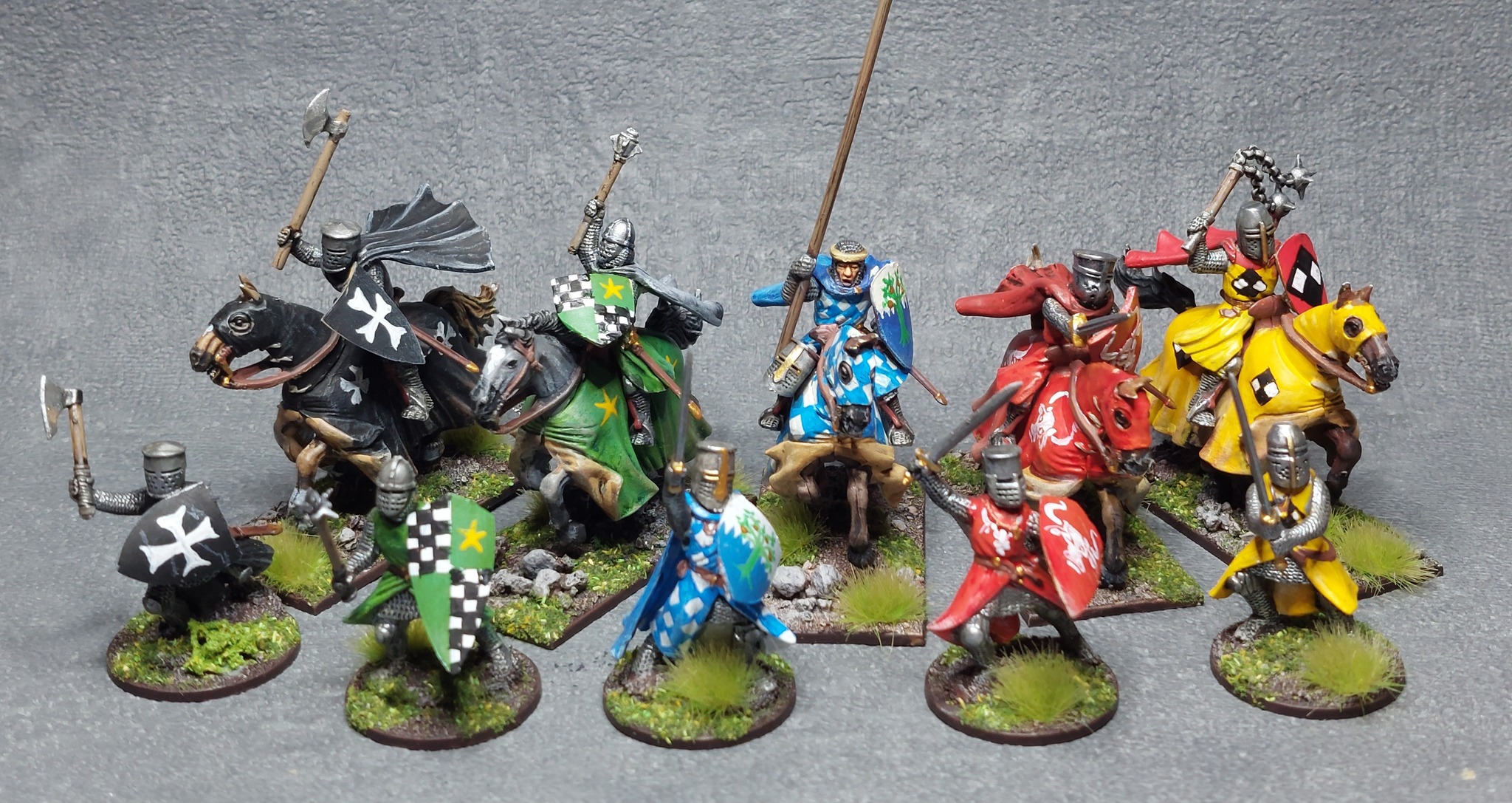 |
| Fireforge knights |
The Rules
The rules offer a mechanism with alternate unit Activation, which offers
the unit the choice to perform an Action or use an Action for a reaction. Most
Units have only one Action but some elite or commanding units have more.
Commanding units may give additional actions to other units. When a unit
Activates twice in a turn it becomes Weary and suffers from die roll
penalties.
Actions include Moving, Combat, Defending, Commanding or using an
Ability.
Units come in types (Knights, Spearmen, Archers for example) and classes
(Veteran, Regular, Irregular and Green). Type determines their standard and
optional equipment and class determines their stats and possible
Abilities.
Of course combat is the gist of any wargame. So how does that pan out?
The Combat mechanism is pretty complicated and is explained on the QRS
by a 11-step flow chart. In itself this is not unexpected in a skirmish system
with a high degree of figure individuality.
In short, after the conditions for entering combat are met the attacker
rolls for Charging distance (which may win or lose him an Attack die), makes
contact and rolls Attack dice. The Defender has decided to use an Action in
Defence or not, rolls Defence dice, adds possible Action modifiers, rolls
Shield rolls (a kind of extra Save) for failed Defence rolls and when
applicable executes his Defence Action. Both groups then move away from each
other while the loser may be Forced back further and may have to make Morale
checks. You get the idea why a flow-chart would come in handy...
But there are some surprising contrasts in combat. While the combat
mechanism in itself is complex, the rest of combat is extremely
simplified.
For example; when a figure loses its last Health Point it is dead. But losing 1 of several does not cause any effects. The wound is simply lost. There is no "Wounded" condition.
While Line-of-Sight is a condition for a Charge, units have a field of sight of 360 degrees. So attacking someone from behind or in a flank has no influence whatsoever.
It was not what I expected from a skirmish game of some granularity, especially since figures and characters can be highly individualized. Such granularity is present in some places but completely absent in others.
Some aspects of the game seem overly complex. The game uses 8 different
counters to indicate that a unit has done or experienced something. But as far
as I can see, Broken, Shocked, Weary and Defend are the only ones with any
specific effect. The other four could have been simply "Activated"
counters. This results in a LOT of counters on the table (although you could
play them on the unit card) and a lot of rummaging around for the right
counter.
The how's, why's and consequences of Morale checks (made to benefit from a Command or as a Reaction to something scary) are complex as well. Being spread out over three chapters doesn't make it any easier to grasp but there are also two different Morale consequences, Broken and Shocked, that are caused by different things and have completely different effects. At the same time, Shocked units might become Broken but not the other way around.
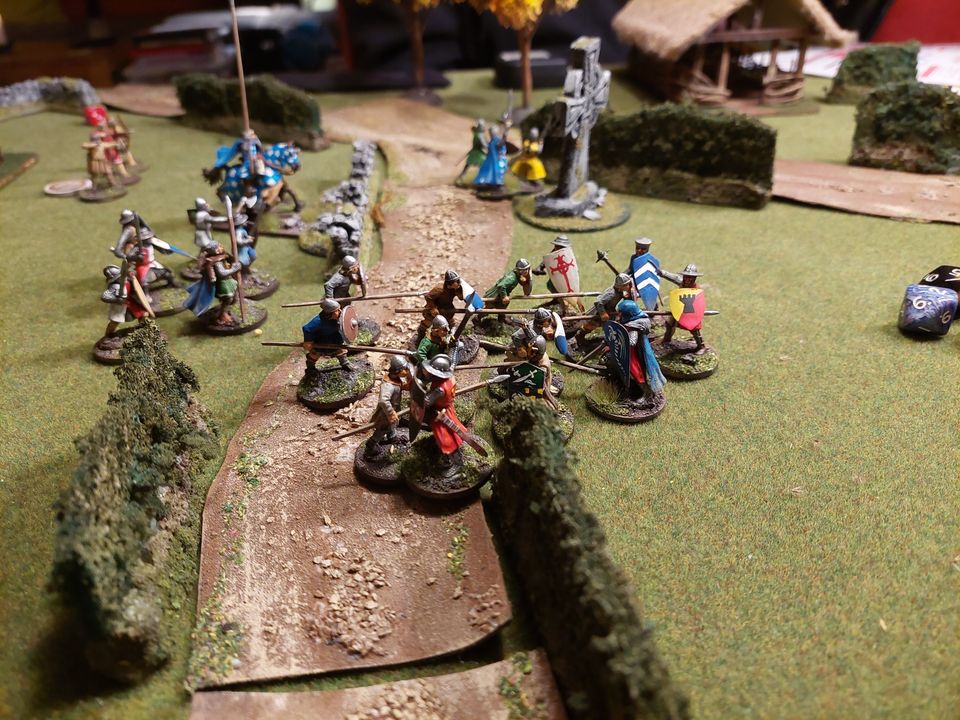
So what is good?
The game is obviously very carefully and lovingly made and the book and
the rules show this. Production value of the book is excellent.
Although several expansions have already been published the game is very
complete in its own right. This is a well laid-out ruleset which includes
historical background, complete army lists, scenarios, terrain tips and lots of
possibility to flesh out your army with all kinds of individual traits and
Abilities. There is even an army list for Robin Hood and his Merry Men as well
as stats for several historical figures to feature in your games.
The rules offer you a relatively quick-playing and classic war game
which can yield clear and bloody results but may also give you tense to-and-fro
battles. The fact that Commanders actually have a Commanding function in the
game definitely is a good thing.
And if you don't already own a medieval 28mm collection the game is
supported by the Footsore range of figures, sculpted by the magnificent Paul
Hicks.
What could be better?
As rules mechanisms go, this one is a bit of mixed bag. Maneuvering and getting into combat or range is a simple affair, but the actual combat is a very complicated procedure which ultimately produces very simple results: some figures die, a mutual move backwards and a possible Morale result. Which makes it hard to determine what is gained by the complexity when it IS there.
Some choices are puzzling. For example: why is a
Shield roll a separate Save while Armour is included in the figure's
stats? Why, in what is after all a relatively complex skirmish game, are there no field-of-vision of rear- or flank attack options so maneuvering would be much more interesting? I would gladly exchange the complicated combat sequence for more challenging maneuvering options. And why not have both? This is a skirmish game afer all.
Keeping track of all the different actions and their consequences with
the numerous counters can be a laborious and cluttery affair.
Rules, especially the Morale rules, are not confined to the Morale
chapter but are rather randomly spread out over several chapters, making them
not only hard to find but also making it difficult to grasp how they work
together.
 |
| Perry trumpeter and Fireforge knight |
Conclusion
The Barons' War offers a good and classic medieval skirmish game. It is
not innovative or as challenging as it might have been but it is well made and very well supported. There are others
like it (like Ospreys Outremer: Faith and Blood) but the Barons' War does its
job well.
